Michiel Roodenburg
Activities:Online supermarket transitioning towards regenerative food
Founder:Michiel Roodenburg
Launched:2018

Introductie
Our food system is depleting what it is meant to sustain. It undermines our health, exhausts the soil, and puts pressure on animals and farmers alike. At the same time, making healthy choices remains complicated. Crisp founder Michiel Roodenburg wants to change that – not by preaching, but by making better choices easier, and more appealing. “Change can taste amazing.”
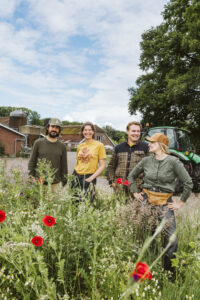
 Michiel Roodenburg: “The way we treat plants, animals, fungi and the soil directly shapes the flavour of what we eat.” Photographer: Gabriela Hengeveld
“We’re not activists. But we do see that the way we produce and consume food is exhausting both us and our environment”, says Michiel Roodenburg. “We want to redesign the food chain – and encourage people to move with that change in a positive way.”
That conviction didn’t come out of nowhere. From an early age, Michiel was fascinated by the role food plays in our lives. After studying economics and completing a postdoc in finance at VU Amsterdam, he began his career at Ahold Delhaize, one of the Netherlands’ largest food companies. In the years that followed, he developed a deep understanding of how the system works – and where it begins to break down.
“I saw up close how an unhealthy diet can affect the quality of life later on”, Michiel reflects. “It made me increasingly uncomfortable with certain products. That feeling only grew stronger with the rise of those brightly coloured energy drinks – they look appealing and sound healthy, but have no place in a healthy diet. With aggressive marketing and a limited understanding of what’s actually good for us, making healthier choices becomes increasingly difficult. We shouldn’t tempt ourselves with more sugar – we should be helping each other. That’s what I want to do with Crisp.”
Uitgelichte quote
Why is the system so poorly equipped for the future?
 Michiel Roodenburg: “In a short supply chain, you hardly need any additives – which makes the product purer.” Photographer: Gabriela Hengeveld
 “We want to help reshape the food system.” Photographer: Gabriela Hengeveld
A system under strain
At the same time, Michiel began to see that taste does not exist in isolation. The way we treat plants, animals, fungi and the soil directly shapes the flavour of what we eat. “And I started to understand that our food system is simply not sustainable – not for our own health, nor for animals or the soil. When I had children of my own, something shifted. I knew I wanted to change this.”
Former classmates Tom Peeters and Eric Klaassen recognised the same tensions. Together, they began to unpack the questions behind them: why is good food so difficult to access? Why does it take so much time to make conscious choices? And why is the system so poorly equipped for the future?
“We started thinking about the solutions we need – and how to create systemic change at scale. We want to help reshape the food system. We take that responsibility seriously, and we believe it’s possible through taste. Gradually, our ideas took shape, and in 2018 we took the leap and founded the online supermarket Crisp.”
Uitgelichte quote
One of the strengths of our system is that we don’t have to reorganise shelves
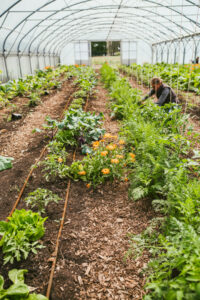
 Michiel was photographed on the Dutch regenerative farm Schevichoven. Photographer: Gabriela Hengeveld
 Michiel Roodenburg: “We can also offer products that are only available for a short period of time.” Photographer: Gabriela Hengeveld
Rewiring the food chain
In its mission to help reshape the food system, Crisp focuses on sourcing as locally as possible – seasonal produce from small-scale farmers and makers. Supply chains are short, with a fair distribution of value, creating a financially sustainable model for everyone involved. Today, the supermarket employs around 1,300 people and reaches some 750,000 users. But Crisp is more than a healthy online supermarket; it is also a tech-company.
Its app connects over 900 farmers, growers and producers directly with consumers, and is designed around a different kind of food system. Wherever possible, products are only sourced once customers place an order – keeping them fresher for longer and reducing waste. “In a short supply chain, you hardly need any additives, which makes the products purer too”, Michiel explains.
Unlike traditional supermarkets, Crisp doesn’t rely on fully stocked shelves. There’s no need to discount surplus or deal with empty gaps when supply fluctuates. Instead of lowering prices when there is an oversupply, products are given more visibility through recipes, promotions or inclusion in meal boxes. When supply is limited, products simply disappear from the app, and customers are offered alternatives.
“Because we work with the seasons, there are moments when certain products aren’t available”, says Michiel. “But the essentials are always there – and if your favourite apple isn’t in stock, we’ll offer a different option. One of the strengths of our system is that we don’t have to reorganise shelves, which means we can also offer products that are only available for a short period of time.”
Uitgelichte quote
You can’t separate health from biodiversity or water management
 Michiel Roodenburg: “We’re not going to shift that by talking about biodiversity, nitrogen emissions or water quality.” Photographer: Gabriela Hengeveld
 “We’re a brand built on flavour – that’s where we want to stand out.” Photographer: Gabriela Hengeveld
“Changing behaviour is anything but straightforward”
Michiel sees Crisp as a way to gently guide people towards more conscious choices. “I believe almost everything in society is interconnected. You can’t separate health from biodiversity or water management. The way we produce food today puts too much of a strain on farmers, animals, soil and biodiversity. We see a future-proof food system as an ecosystem in balance – one that requires as little external intervention as possible. When you shorten the chain, you can make shared decisions that support that system: different ways of producing, and different ways of eating. Our farmers move with nature as much as possible.”
Changing behaviour, however, is anything but straightforward. When it comes to food and grocery shopping, habits run deep. “We’re not going to shift that by talking about biodiversity, nitrogen emissions or water quality”, Michiel says. “Those arguments often don’t resonate. In the food transition, what really matters are happiness, costs and convenience – and, for me, health belongs in that list too. If you want to bring people along, you have to connect to those benefits. We’re priced at the level of mainstream supermarkets, and we see that the convenience of home delivery and the pleasure of taste are key reasons people choose Crisp. We’re a brand built on flavour – that’s where we want to stand out.”
Uitgelichte quote
I strongly believe that regeneratively grown food is more nutrient-dense
 Michiel Roodenburg: “Our food system is depleting what it is meant to sustain.” Photographer: Gabriela Hengeveld
 “We choose to support regenerative pioneers – farmers willing to take that step.” Photographer: Gabriela Hengeveld
Scaling the shift to regenerative
In 2024, Crisp became the first supermarket in the Netherlands to receive B Corp certification – a recognition of its efforts to operate more sustainably. For Michiel, however, it’s not a finish line, but a tool to deepen and expand their impact.
Crisp’s ambitions for accelerating the agricultural transition are equally bold. By 2030, at least 30 per cent of the fruit and vegetables it sells should come from regenerative farms. “Organic farming is an essential step”, Michiel says, “but ultimately you also want to move beyond monocultures and reliance on external inputs. That doesn’t happen overnight – this kind of transition takes time, for farmers as well as consumers. I strongly believe that regeneratively grown food is more nutrient-dense. That’s why we choose to support pioneers – farmers willing to take that step – by working closely with them.”
“We’re still a relatively small player in the supermarket world. But because of how we’re built, we’re fast and flexible, and able to grow quickly”, Michiel says. “Regeneration is the direction we need to move in – and want to move in. I see every day that it’s possible.”
Also read our interview with the founders of regenerative supermarket chain OOGST (Dutch for ‘harvest’).