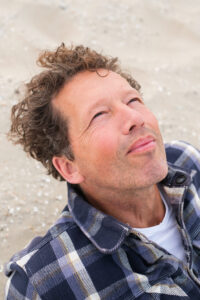
Emile Corre
Activities:Kickstarting regenerative food enterprises
Founder:Emile Corre
Launched:2015
Location:Culemborg

Introductie
Regenerative entrepreneur Emile Corre is constantly searching for ecological alternatives to familiar products – from tempeh made with forgotten bean varieties to alcohol free wine and iced tea brewed from local herbs. “Our aim is to turn regeneration and rewilding into a healthy business model.”
Over the last decades, biodiversity has been dismantled at an alarming speed in the Netherlands. The landscape has become monotonous, native species have disappeared from the profit driven food industry and food itself has shifted from nourishing to destructive. Whilst real flavour is born of a rich, diverse landscape. To turn the tide, the Dutch enterprise Fruitslagers (‘Fruit Butchers’) develops cultivation plans to restore that landscape, working with local farmers to create short supply chains, reduce emissions and build a healthy, decentralised economy.
Uitgelichte quote
My father was born in Brittany, into a fishing family that harvests seaweed from the Atlantic Ocean


Two worlds
At the helm of Fruitslagers stands Emile Corre. Half French, half Dutch, Emile grew up in Blijkmeer, near Amsterdam. “It was a kind of garden park, where we lived together with several families”, he says. “My mother comes from a household of squatters and artists and my father was born in Brittany, into a fishing family that harvests seaweed from the Atlantic Ocean. In Brittany we were constantly engaged with the sea; in the Netherlands we lived literally in and from nature. If you grow up like that, you can’t help but want to take care of nature. For me, nature is more important than humans – if nature is healthy, people will follow.”
Uitgelichte quote
The more intense, the more exciting it is for me. But most Dutch people don't see it that way
 Emile Corre: “Food has become destructive rather than nourishing.” Photographer: Sabine Rovers
 Photographer: Sabine Rovers
Ethically uninteresting
At age fourteen, Emile was inspired by Ferran Adrià, the chef who made molecular gastronomy big. From that moment on, he could be found in the kitchen most days. After graduating, he travelled the world to understand how the food system works. “I went from Kazakhstan through Vietnam to the Mediterranean, picking olives, making wine and slaughtering sheep, simply to understand how our food is produced. I even ended up in Paris, in some of the more upmarket restaurants. However, I soon realised that wasn’t for me. The better you cook, the wealthier your guests become and the less connection you have with the wider public. You end up serving caviar and lobster… I found that ethically uninteresting, because I wanted to teach people something about their food.”
Uitgelichte quote
We think from landscape to product

 The team of Fruitslagers. Photographer: Sabine Rovers
Five brands, five ways to restore the landscape
After his travels, Emile founded Fruitslagers (‘Fruit Butchers’), through which he aims to regenerate the Dutch landscape. Because this can be done in many different ways, the regenerative enterprise now encompasses multiple brands:
Roze Bunker
Roze Bunker addresses various problems within the food industry. With its syrups – used for soft drinks, aperitifs, cocktails or mocktails – consumers contribute to biodiversity, shorter supply chains and circular production. “Roze Bunker was our first product”, Emile explains, “to show that you can improve agriculture with a so-called ‘negative’ product.” Unlike conventional soft drinks, Roze Bunker syrups are not packed with additives but made from native flowers and herbs that benefit soil life and insects. In addition, residual streams such as lemon peels left over from the limoncello industry are incorporated. What remains after the production is reused in condiments such as sauces and marmalades.
Boonzaak
Boonzaak produces tempeh from Dutch beans and a small amount of mycelium. Tempeh is a natural source of vitamins, fibre and protein that the body absorbs and digests easily – partly thanks to the fermentation. Beans are not only good for human health; they also fix nitrogen and improve soil life. “The goal is to put this beautiful product into our own mouths, not into animals”, Emile says.
Cul Sec
Cul Sec is the latest brand: an alcohol-free alternative to wine, made from wild herbs and grapes. “We think from landscape to product”, Emile explains. “Which crop fits this place, and what product can you make from it?” Grape cultivation in the Netherlands is challenging due to limited sunshine in late summer, resulting in insufficient sugar levels for conventional wine. For an alcohol-free drink, however, less sugar is required, making grape cultivation far more viable.
Test Kitchen and Field Guide
Products in the Test Kitchen are made from residual streams from the company’s own production – think fermented sauces, vinegars and syrups. Field Guide consists of alcohol-free spirits inspired by the Dutch landscape, with flavours such as smoked peat and meadowsweet.
Uitgelichte quote
We don’t aspire to be one big brand – we want to pioneer and bring others along
“We’re here for change, not for business”
Alongside their brands, Fruitslagers also runs a restaurant, Cul Sec Resto, and its own production facility: Food Station. In the restaurant, visitors can taste what comes from the growers and the production process. “Are we the only super-nerds who enjoy this, or do others too?”, Emile asks. “For me it’s often: the more intense, the more exciting. But most Dutch people don’t feel that way.”
Food Station is shared with other entrepreneurs working on regeneration. “We set it up because we wanted to share our production knowledge. We don’t aspire to be one big brand – we want to pioneer and bring others along. We’re here for change, not for business. Entrepreneurship simply makes that change possible.”
Other entrepreneurs can take out subscriptions at Food Station and, when capacity allows, source from the same growers. “It’s mainly about sharing knowledge and decentralising production. So multiple autonomous parties can run their own businesses whilst sharing the costs of machinery.”
Uitgelichte quote
What if we all started eating nordic olives?


From rewilding to self-harvesting
With the existing brands now firmly established, Emile is turning his attention to future projects. One idea is a Dutch alternative to olives: premature fruits such as walnuts, plums, almonds or peaches, processed like olives until they develop a similar flavour. “What if we all started eating nordic olives in the Netherlands? Which trees would we need to plant? And what would that do to the landscape? Those are the questions that occupy me”, he says.
Emile is also searching for a place to establish a test farm focused on product development. “As a French winemaker, you are land-bound: you create a product that emerges from your land, and the terroir determines its characteristics. In the Netherlands, we often think from the end product backwards, almost forgetting nature. Whilst our product developers work from the landscape. Which ingredients contribute to a healthy food landscape, and what can we make from them? The farm will be a place where we test different cultivation methods – from rewilding to self-harvesting gardens – and develop new products. Not in order to replace our current collaborations with farmers, but to scale them.”
Uitgelichte quote
We want to create space for multiple generations to pioneer


The continuity of slow growth
“In agriculture, we often pretend we know how things should be and where we’re headed, but we need to reform farming, and nobody knows exactly what that will look like”, Emile says. “We are human, and nature emerges. I don’t believe we hold the truth, or that there is only one truth. That’s why I think: open 40 farms in the Netherlands for experimentation and research what actually works over the course of fifty years.”
That pioneering mindset also explains why Fruitslagers frequently says ‘no’ to large-scale players such as national supermarket chains. “Too often we see retail turn products into hypes, which then either collapse or are taken over by a major player like Unilever. We believe in the continuity of slow growth. We want to offer space for multiple generations to pioneer with food. And we want to maintain our own autonomy. We have no investors or external capital. All we have are vegetables, herbs and a handful of very good partners and farmers we work with. That is our capital.”
Looking for more regenerative entrepreneurs? Take a look at our interactive map.
Originally published on the 5th of February 2026. Latest update: 18th of March 2026.