Wouter van Noort: “We must relearn how to relate to all other life – to which we are so deeply connected”

As humans, we must relearn how we can live alongside other species, according to Dutch NRC-journalist Wouter van Noort. Each week, together with hundreds of thousands of readers, he examines the defining ecological questions of our time. “What amazes me is how many people don’t realise how intelligent bees are, or that plants can communicate with one another, or that trees have senses”, he says. “I want to shift how people see the living world.”
Until a few years ago you wrote about technology. What prompted the shift to ecology?
“For me, 2020 marked a turning point. I became a father, the pandemic started one month after my son was born, and in that same year my mother died. Taken together, it pushed me to take a sabbatical, travelling through Europe for four months in a camper with my family. Before that, I had already been engaging with sustainability from time to time, but during that journey it became clear that I wanted to write about ecology from then on, because the changes in nature had become impossible to ignore – melting glaciers, wildfires that forced us to evacuate twice, drought. It’s confronting to encounter that firsthand, rather than through headlines or reports.
At one point I was standing with my son in my arms, looking at a glacier, and it suddenly struck me: when he stands here one day with his own child, that glacier will no longer be there. The fact that he won’t be able to admire it is not the worst part, of course, but it does show how fast the changes are happening and how deeply they impact entire ecosystems. Those glaciers feed the rivers and the entire water system around the Alps, and countless forms of life depend on that.”
Uitgelichte quote
It’s confronting to encounter it firsthand, rather than through headlines or reports
 Photographer: Diane van der Marel
 Wouter van Noort: “When he stands there one day with his own child, that glacier will no longer be there.” Photographer: Diane van der Marel
You started by tackling the theme of symbiosis. Why?
“Symbiosis literally means ‘living together’ in ancient Greek. It is an organising principle in nature in which multiple species coexist over long periods in ways that benefit all involved. Alongside competition, there are many other mechanisms at work in nature, and symbiosis is one of them. I am convinced that a large share of the problems we face today stems from the fact that we live too little in symbiosis with the rest of life.
So, in the first phase after my sabbatical, I immersed myself fully in the concept: what is symbiosis? What might a symbiotic city look like? And how does it function in nature – for instance in lichens?”
Uitgelichte quote
Lichens defy the classical boundaries between organisms, individuals and identities
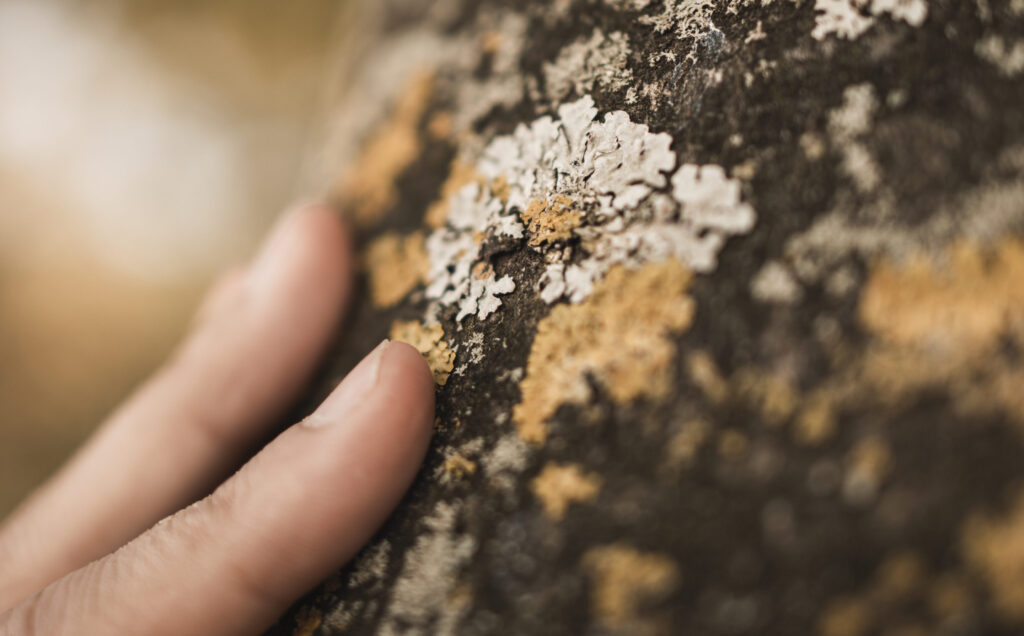 Wouter van Noort with his beloved lichens: “They are not mosses at all, but unique collaborations between algae and fungi.” Photographer: Diane van der Marel
 Photographer: Diane van der Marel
Lichens are one of your fascinations. Tell us more.
“Lichens are extraordinary. They come in an astonishing range of forms – almost coral-like, fringed, or tufted like hair. They can be every colour of the rainbow, sometimes live for thousands of years, and endure almost anything. Recently, a lichen was found on the International Space Station that was still alive, despite exposure to extreme heat, cold and radiation. They occur everywhere on Earth, are estimated to cover six to eight per cent of the planet’s land surface, and there are at least 20,000 known species.
Above all, lichens are archetypal symbionts; the term ‘symbiosis’ was literally coined in biology to describe their way of living together. They are not mosses at all, but unique collaborations between algae, which handle photosynthesis, and fungi, which provide structural support. In doing so, they defy classical boundaries between organisms, individuals and identities. Another important thing about lichens: they usually live with their substrate, not off it.”
Uitgelichte quote
It’s a misconception that humans stand above nature. But our systems are still organised around this misconception
 Wouter van Noort: "A healthy soil is inseparable from a healthy human." Photographer: Diane van der Marel
 Photographer: Diane van der Marel
Most people don’t behave in a symbiotic way, but believe they stand above or outside nature. Where does this idea come from?
“Over the past years I’ve had many conversations with thinkers on this subject, and Philipp Blom sharpened my understanding. His book Subjugate the Earth traces the history of the misconception that humans stand above and outside nature – because that is what it is: a misconception. More than half our cells are non-human. A healthy soil is inseparable from a healthy human. And there is growing evidence that even something considered ‘uniquely human’, such as consciousness, may occur far more widely in nature than we once thought. That remains more speculative than, for example, the link between our gut microbiome and the soil microbiome. But across almost every branch of science, the assumption that we stand above and outside of nature is being challenged. At the same time, our systems are still organised around that misconception.
What Blom describes so compellingly – and forcefully – is how deep the roots of this misconception run. They can be traced back to the earliest Abrahamic religions, including Judaism and Christianity. Consider the creation story, in which humans are created last, in God’s image, and sent into the world with the instruction: multiply, rule over the fish, the birds and all other animals, and subdue the Earth. The Enlightenment and capitalism then turbocharged this worldview, to such an extent that dismantling it will take time. But that is the task: instead of seeing ourselves as separate, we must relearn how to relate to the rest of life, to which we are so deeply connected.”
Uitgelichte quote
You have to remain critical and keep gathering counterarguments
Shouldn’t the media play a much bigger role in this?
“I think there could be a better balance between describing what is going wrong and showing how things could be different. If you were to line up all the front pages of almost any newspaper over the course of a year, you might think: what kind of world is this? It can leave you feeling completely hopeless. That said, this is not a plea for ‘positive news’ or so-called constructive journalism – you must continue to name what is going wrong. If we reach tipping points in the Earth system, that has to be reported, even when there is no immediate solution. But as journalists we hold an enormous spotlight, and with that comes the responsibility to occasionally turn it towards the hopeful – towards initiatives that are moving in the right direction.
What amazes me, for instance, is how many people still don’t know how intelligent bees and bumblebees are, or that plants can communicate with one another, or that trees have senses and can even perceive the world. These are not brand-new scientific discoveries. Yet simply naming them, illustrating them with strong examples and new research, already shifts something. It makes people think: oh yes – we humans are nature. At the same time, it remains a search, because constantly gazing at the world with wide-eyed wonder doesn’t strike me as a healthy journalistic stance either. You have to remain critical and keep gathering counterarguments.”
Uitgelichte quote
Where do we want to go? And what shared drivers, values and desires underpin that future? That is what I want to explore
Can you give an example?
“Many pioneers I speak to, or thinkers with bold ideas about how society or the economy could be organised differently, remain far smaller than the mainstream. Recently, for instance, I delved again into the clothing industry – ultra-fast fashion – and the speed at which those companies are growing. No regenerative fashion pioneer can compete with that. Even with regulation and sustainability requirements, it remains extremely difficult to build serious alternatives at scale.
The same applies to food forests. They are a beautiful and hopeful development, and experimentation matters. At the same time, we must acknowledge that they are not yet productive enough; we cannot feed the entire world with food forests alone.”
Uitgelichte quote
That monolithic thinking of either industrial agriculture or food forests is the wrong way of looking at things
 “We must relearn how to relate to all other life – to which we are so deeply connected." Photographer: Diane van der Marel
 Wouter van Noort: “More than half of our cells are non-human.” Photographer: Diane van der Marel
Perhaps that isn’t necessary, and we instead need a plurality of solutions.
“Yes, that monolithic thinking of either industrial agriculture or food forests is indeed the wrong way of looking at things. Still, taken together, all these solutions must add up to meaningful change – and at the moment that often happens too slowly. What I also notice is that many regenerative pioneers struggle to move beyond the ‘cute’ category. I was recently at Triodos Bank, and they wrestle with this too; lack of scale remains a real obstacle. Personally, I haven’t fully resolved this yet, because it seems to clash: the drive for scale, growth and size may be precisely what we need to move away from.”
Uitgelichte quote
It seems to clash: the drive for scale, growth and size may be precisely what we need to move away from
You spent many years focussing on technology. Can it help place ecology at the centre?
“Most technology is still used for extraction and exploitation – and that is no accident. The business models of major tech companies are built on extracting and exploiting data. It’s the same extractive worldview. Yet technology could also be designed around symbiotic principles. Take AI, for example, and the decoding of whale language, allowing us to recognise patterns in whale song and begin to understand what these animals are communicating. You could imagine something like a Google Translate for animals.
But technology can also come directly from nature itself, such as Bob Hendrikx’s living coffins made from fungi. It may sound trivial, but it is brilliantly conceived, because it builds on what fungi have always done in nature: recycling dead organisms. And what Justdiggit does in Africa is a phenomenal example of the impact of a very simple, low-tech intervention: digging pits that retain rainwater, allowing plants to grow, attracting insects, which in turn leads to more plants, and eventually shrubs and trees. So yes, symbiotic technology exists. But it remains small and gentle. Big tech is still far bigger.”
Uitgelichte quote
What excites me are developments where grassroots initiatives and top-down systems meet and reinforce one another

In your view, how do we create change at scale?
“What excites me are developments where grassroots initiatives and top-down systems meet and reinforce one another. Take the success of solar energy. That is partly thanks to subsidy schemes, but also to energy collectives and citizen cooperatives that have made it far more attractive to get involved. What you see there is a powerful combination: something that would never have progressed so quickly without top-down policy and tax measures, yet spread and evolved from the bottom up through citizen initiatives.
I also keep returning to that symbiotic worldview. If we considered that cities should not only be liveable for humans, but also for birds and bats, an entirely different set of priorities would emerge – one through which many problems could be addressed. And we must not forget complexity. Restoring forests is good for carbon storage, but one of the most effective things you can do for the climate is increase whale populations. Because whales stir up algae, attract other marine life, and create currents and exchanges between water layers, accelerating carbon uptake in the oceans.
That’s why I try to stay away from quick fixes and focus instead on new ways of seeing, rooted in a different relationship with nature – without turning myself into some kind of sustainability prophet.”
Uitgelichte quote
I try to stay away from quick fixes and focus on new ways of seeing
 Wouter van Noort: "What is the Netherlands we want? And what shared drivers, values and desires define it? That’s what I want to explore." Photographer: Diane van der Marel
 Photographer: Diane van der Marel
How would you describe your role, then? Not a prophet, but…
“I like the term ‘weaver’. Someone who tries to bring different threads together and weave them into a whole. A more personal metaphor for my work – something I rediscovered during my sabbatical – is shell collecting. Once a week I go to the beach to look for shells and fossils, and at home I arrange them in a small cabinet. I clean them, rearrange them, change their order.
That is essentially what I do in my work as well. I look for a beach scattered with shells – ideas – and pick out a few. And then I have a display window in which I can present them, like a curator of solutions.”
Uitgelichte quote
That inviting perspective is ultimately what gets people out of bed
What is the next ‘shell’ to enter your museum?
“Symbiosis will remain a key theme for some time, as will the question of how we can improve our relationship with the rest of the living world. And I’m working on a new idea. In the Netherlands we so often focus on what we don’t want, which leaves little room for imagination. We are now eighteen million people – what is the Netherlands we do want? In which direction do we want to go? And what shared drivers, values and desires underpin that future? That is what I want to explore. In the end, it is that inviting perspective that gets people out of bed.”
Looking for symbiotic inspiration? Dive into our interview with Bob Hendrikx, who makes living coffins out of fungi.
Original publication date: 16 October 2024. Latest update: 31st of August 2026.
Who is Wouter van Noort?
As a journalist at NRC, a quality Dutch newspaper, Wouter van Noort (1985) focuses on the future. Together with more than 140,000 followers and readers of his work, he explores the major transformations shaping our time – from symbiosis to AI. He gives guest lectures at several Dutch universities and is co-founder of Symbiotic Shift, a community event exploring how regenerative choices can be made in our lives and work.

READ MORE:

Nora Bateson: “How our ways of knowing shape our collective future”
8 April 2026