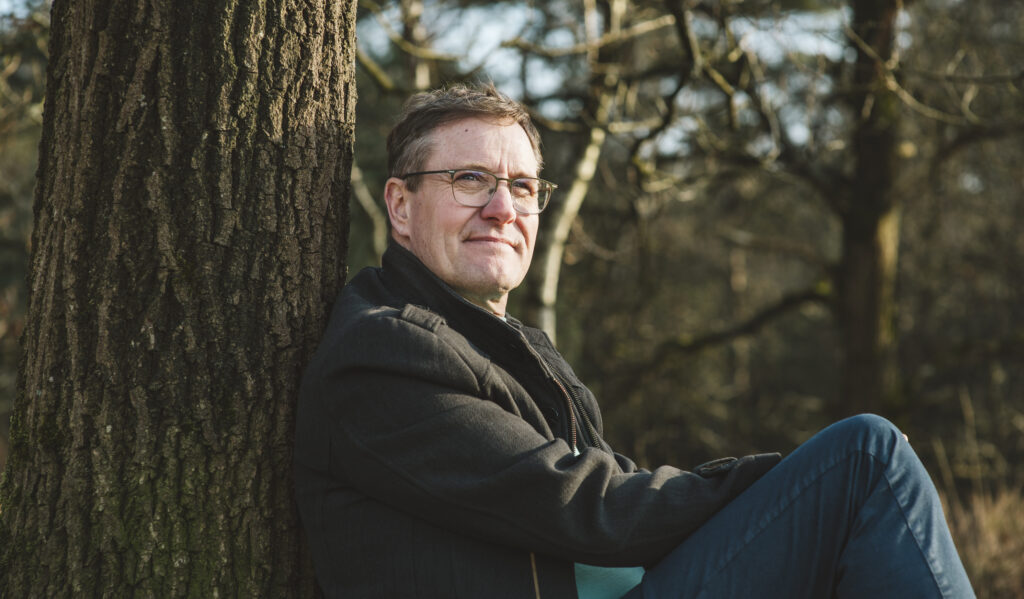
Hans Stegeman: “We sustain the system at all costs, blinded by the fear of losing what we know”

“The economy needs to keep growing to function”, says Hans Stegeman, “whether that actually makes us happier or not.” In his PhD research, the Chief Economist at Triodos Bank examines the deeper mechanisms driving our obsession with growth and explores how we might shift towards an economic system that supports life rather than depletes it. “I’ve grown more nuanced – perhaps even a little gentler towards mainstream economics.”
You recently completed your PhD. What motivated you to start it?
“I’ve spent my entire professional life doing research – first at the trade union, then at the Dutch Bureau for Economic Policy Analysis, and later at Rabobank. Over the years, people would often tell me: ‘You should write a dissertation.’ I even started one about ten years ago, but the timing wasn’t right.
The right moment arrived a few years ago, during a conversation with Dirk Schoenmaker, a professor at Erasmus University. He told me: ‘If you’re going to do it, take on the big, difficult questions.’ That struck a chord. I wanted to take the time to really reflect on the fundamental problems within our economic system – in a way that goes deeper than a column or an article. Not as a career step, but out of genuine curiosity and a desire to understand.
The central question I eventually explored was: how does our current economic system function, with all its flaws — and how might we evolve towards one that is ecologically and socially sustainable in the long term?
So I examined what’s going wrong, both in theory and in practice. Why doesn’t the current system work? And how can we reimagine it as an economy that is sustainable in theory, policy and practice – a system that supports life rather than depletes it?”
Uitgelichte quote
If you’re going to do it, take on the big, difficult questions
 Photographer: Sabine Rovers
 Hans Stegeman: “I don’t understand why more economists aren’t curious about these questions.” Photographer: Gabriela Hengeveld
That’s quite a big question.
“Yes, it became a broad, interdisciplinary study – but it couldn’t really have been any other way. At least, not for me. And honestly, I don’t understand why more economists aren’t curious about these questions.
We should all feel compelled to look beyond the boundaries of our own discipline. To ask ourselves: how is it possible that, despite all our economic theories and assumptions about prosperity and progress, the real world keeps moving in the opposite direction?”
Uitgelichte quote
How can intelligent people spend years working with models they know are flawed?
One of those assumptions is that growth is both good and necessary. How does that work exactly?
“It’s often presented as if the economy grows because it means people are better off that way. But this is only true up to a certain point. In recent decades, economic growth has stopped contributing to happiness. That’s not what drives it anymore. Our system is institutionally dependent on growth – it’s been designed in such a way that it must keep expanding simply to function, regardless of whether it makes us happier or what it does to the living world.
Yet within economics, hardly anyone examines this from a systemic, macro perspective. The focus tends to be on individual behaviour – microeconomics – which is then aggregated to the macro level. But that’s often where things go wrong, because what’s optimal for individuals doesn’t automatically add up to what’s best for the whole.
In most sciences, an assumption stands until it’s proven false. In economics, it doesn’t work that way. It’s still assumed that companies drive innovation, that nature and people can always be substituted by capital, and that every ecological problem can be solved by pricing its negative effects. And then there’s the extreme reductionism: the belief that an economy is simply the sum of its smaller parts.
I’ve always wondered: how can intelligent people spend years working with models they know are flawed? There’s a deep tunnel vision within the field.”
Uitgelichte quote
Economists are exceptionally good at defending their own paradigm
 Hans Stegeman: “In recent decades, economic growth has stopped contributing to happiness.” Photographer: Sabine Rovers
 “What’s optimal for individuals doesn’t automatically add up to what’s best for the whole.” Photographer: Sabine Rovers
And you can’t easily question that.
“No. Economists are exceptionally good at defending their own paradigm. The moment you point out contradictions between theory and reality, you’re quickly dismissed and told that you’re not a ‘real economist’.
This shows how deeply embedded these ways of thinking are. Within the field, there’s hardly any space left for the bigger question: what, if anything at all, still works about this system?”
Uitgelichte quote
No one is rewarded for trying to understand the bigger picture
Though it’s not just stubbornness, is it?
“Of course not. Most researchers simply do what the system rewards – specialise and publish within your own narrow field. No one is rewarded for trying to understand the bigger picture. And that’s not unique to economics. Reductionist thinking runs through everything: science, politics, education. We’ve all been trained to break complexity down into manageable pieces because it feels more controllable that way. But in doing so, we lose sight of what’s really going on.”
In your dissertation, you write that today’s economic theory is a product of its time.
“Yes, that’s important to recognise. Our current economic thinking was largely shaped between the two world wars and the years that followed. Thinkers like Keynes, Polanyi and Schumpeter were responding to the challenges of their era – mass unemployment, reconstruction, the drive for production.
Ecological sustainability simply wasn’t part of that conversation – and understandably so, it wasn’t the most pressing issue then. That thinking served its purpose at the time, but we’ve failed to adapt it to the challenges we face now. We’ve forgotten to bring time along with us. In a way, that’s understandable – the system benefits certain interests – but it’s still tragic. We should have changed course long ago.
At the same time, nothing in my dissertation is truly new. Even in the 1930s and 1950s there were thinkers who already saw the problems and offered ideas that now make you wonder: how did we lose sight of this? Discovering this was humbling. The deeper you dig, the clearer it becomes that people sixty years ago were already thinking what you’re only just rediscovering – what feels like a eureka moment to you.
It’s an illusion to think you can come up with something entirely new. The most you can do is bring existing insights together in a way that reaches more people, helps address the great challenges of our time, and hopefully makes a difference. That, I think, is the modest contribution of my work.”
Uitgelichte quote
Economics is fundamentally a social science, and should behave like one – not like physics
 Hans Stegeman: “We’ve failed to adapt economic thinking to the challenges we face now.” Photographer: Gabriela Hengeveld
 “We should have changed course long ago.” Photographer: Sabine Rovers
What has four years of research brought you personally?
“A few things. I now have a much deeper understanding of complexity and systems thinking – and how you can apply that to economics. Writing this dissertation, for instance, led my team and me to completely rewrite Triodos Bank’s impact strategy. So my understanding of how the economy truly functions has become much richer.
I’ve also become more nuanced, even towards mainstream economics. I still think some assumptions are completely absurd, but the problem often lies not in the original theories – it’s in how they’re interpreted by the policymakers and lobby groups who flatten ideas and reuse them for their own agendas.
And finally, I’ve come to see that economics is fundamentally a social science, and should behave like one – not like physics. Everything in economics is political and normative. Its assumptions can never, by definition, be ‘the truth’.
Take the idea that central banks are apolitical: nonsense. Everything they do with interest rates has economic, social and political consequences. Or the notion that a government deficit should never exceed three percent – that’s not a law of nature, yet it limits what you can do to tackle social and ecological challenges.
That may be my deepest insight: the economy is far more malleable than we think.”
Uitgelichte quote
Growing urgency seems to play straight into the hands of populists
 Hans Stegeman: “My understanding of how the economy really works has become much richer.” Photographer: Sabine Rovers
 “It’s nonsense that central banks are apolitical.” Photographer: Sabine Rovers
If the system is so malleable, why are we still running towards the edge of the cliff?
“Yes, I’ve been thinking about that a lot lately, especially when you look at the political climate. There’s a strange paradox: the closer we get to the edge, the greater the need for change – and yet that growing urgency seems to play straight into the hands of populists. It’s the opposite of what you’d expect rationally.
I see at least two reinforcing forces at work. First: the fear of losing something is a stronger motivator than the hope of gaining. That’s why many people support policies that harm them in the long run, because they offer short-term security. This is reinforced by those who profit from the status quo – they have the most to lose from change, and therefore the strongest aversion to loss.
At the same time, we live in a deeply destabilised economic system that can only keep going as long as it grows. A growth-dependent system is by definition extractive, socially and ecologically. Stop extracting, and growth stagnates; stop growth, and the system collapses. So we keep repeating the same story: growth is good and necessary. We sustain the system at all costs, blinded by the fear of losing what we know.
Most people understand perfectly well that things need to change. They just don’t see how.”
Uitgelichte quote
The fear of losing something is a stronger driver than the hope of gaining
What’s the most important step we need to take?
“If you look at the market, the state and the community, we need to give the community much more space. Less market, perhaps also less government, to make room for other forms of organisation. Let the state facilitate and support, not take over or regulate everything.
At the same time, a new model begins by ending the growth imperative. That means an economy that operates within ecological boundaries. On the social side, it’s harder to define an upper limit – though we have clear lower limits – but it starts with nature. That’s where the real boundaries lie, and within that space you try to optimise socially. The result of that is the economy.
And the same goes for the financial system: it’s a derivative of economic activity, not the other way around. Right now, we’ve completely reversed that order.”
Uitgelichte quote
We need to give the community much more space

You work for a bank yourself. How do these ideas relate to that?
“Working in the financial sector, I see all sorts of structural flaws that keep the system running in strange ways. Financial flows operate globally, and that even constrains Triodos Bank. Our mission is to steer economic activity in a sustainable direction, but we can’t finance everything we’d like to – because yes, we also have to make a return.
These are all human-made constructs that restrict our actions in the real economy. And the more you think about that, the stranger it becomes. Everyone says: we should change the system. But who exactly? That’s all of us. And that brings me back to the community. That’s where the key lies – in building resilience. Local and regional cooperative economies will keep going even if the global system collapses.”
Uitgelichte quote
I distrust people who claim to know exactly how things are
Could biomimicry play a role here, alongside community?
“Look, the economic system is ultimately a social one – and a social system isn’t a natural system. Of course, you can look at underlying principles or draw analogies between the two, but they’re not the same.
When it comes to resilience, yes, you can translate ideas like diversity into economic structures. But it’s not identical.
You might notice this from several of my answers: often, there isn’t a single answer. I distrust people who claim to know exactly how it all works, who are convinced of their own truth. I don’t always know myself. I have hunches, and I know pretty well what doesn’t work, but that’s about it.”
Uitgelichte quote
We have to figure it out together
 Hans Stegeman: "I try to stay somewhat in the middle." Photographer: Sabine Rovers
 Photographer: Sabine Rovers
Maybe that applies to the whole progressive movement.
“Yes, you have to be careful not to fall into the trap of thinking you know. That’s a very bad idea. In fact, I think it’s one of the biggest problems holding back the progressive movement.
That’s probably also why I try to stay somewhat in the middle. I can be quite radical in my thinking, but I operate within the system – precisely because that’s where I can be more credible. I know how a bank works, how the financial system functions. It helps when you can speak from within rather than just shouting from the sidelines that everything must change and that you know how.
And again: the more I study, the more I realise how complex it is. I see patterns, but I don’t know exactly – and that’s okay. We have to move away from the idea that one person has all the answers. We have to figure it out together.”
Original publication date: 25th of October 2025. Latest update: 28th of January 2026.
Who is Hans Stegeman
Hans Stegeman (born 1972) is Chief Economist at Triodos Bank. He obtained his PhD at Erasmus University on the transition towards a socially and ecologically sustainable economic system. Previously, he worked for the Dutch Trade Union Federation (FNV), the Bureau for Economic Policy Analysis (CPB), and Rabobank.
In his work, Hans bridges academic thinking and social practice, offering a clear-eyed view of the tensions between market, state and commons. He advocates for an economy that doesn’t grow for growth’s sake, but flourishes within ecological limits while placing human wellbeing at its core.

LEES VERDER:

Nora Bateson: “How our ways of knowing shape our collective future”
8 April 2026