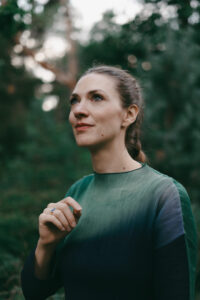
Esther Blom
Activities:Rewilding nature
Founder:Wouter Helmer
Launched:1989
Location:Everywhere in the Netherlands

Introductie
Few countries have shaped their landscape as profoundly as the Netherlands. In a land engineered, measured and managed for centuries, nature is seldom left to its own rhythms. With ARK Rewilding Netherlands, ecologist Esther Blom is pushing back against that logic – helping to create thousands of hectares of new nature while restoring its capacity to organise itself. “Even something small can trigger an explosion of life.”
 “We have to give the landscape space.” Photographer: On a hazy morning
“If nature plants a tree somewhere, it’s because that tree wants to be there. But when you plant one yourself, you have to decide whether it’s the right place, the right time, and the right species”, says Esther Blom, director of ARK Rewilding Netherlands. “Rewilding is the fundamental belief that nature knows best.”
What that way of thinking looks like on the ground becomes clear in a nature reserve in the south of the Netherlands, where ARK is restoring natural processes – and, since 2010, has rewilded over 1,000 hectares of land. “People often assume that a patchwork of agriculture and nature creates the most optimal landscape. But here you see the opposite: when nature forms one continuous system, water levels can rise and wetland dynamics return – exactly as the landscape was meant to function”, says Esther. “These wetlands act like a sponge, absorbing excess water and buffering the effects of climate change. But as long as agriculture remains embedded within that system, it simply doesn’t work. That’s why we buy up fragmented plots of land to reconnect nature areas.”
The organisation Esther leads was founded 37 years ago by Dutch ecologist Wouter Helmer, driven by what was then an unconventional idea: not only to protect existing nature, but to create new nature. “Early on, he realised that environmental problems were simply too large to solve by preservation alone”, says Esther. “So he began to think differently: what if we could create more nature? Because the larger an ecosystem is, the more resilient it becomes. And the more space you give it, the more it can decide for itself what grows and thrives where – rather than being intensively managed or controlled.”
Uitgelichte quote
Over time, you see nature areas becoming large enough for natural processes to return
 Photographer: On a hazy morning
 Esther Blom: “The constant change is what makes the ecosystem so alive.” Photographer: On a hazy morning
Hectare by hectare
Today, ARK Rewilding has rewilded thousands of hectares across seven landscapes in the Netherlands, while acquiring more than 1,500 hectares of former farmland to return to nature. “The land we buy is usually located between existing nature areas. It’s a puzzle we solve hectare by hectare – we almost never buy a hundred hectares at once. Sometimes it’s three, five, twenty. But over time, you see nature areas becoming large enough for natural processes to return”, Esther explains. “In the south of the Netherlands, for example, there is now space again for species like red deer – they simply walk in from neighbouring Belgium. And tree frogs have returned too. It’s incredible.”
Uitgelichte quote
Something relatively small can set an entire chain of life in motion
 Esther Blom: “But we first need to help life return.” Photographer: On a hazy morning
 Photographer: On a hazy morning
Hundreds of species
People often assume that ARK simply buys land and then steps back. “But much of the land we work on has been fertilised for decades, leaving very little life behind – so we first need to help that life return”, says Esther.
The first step is usually to introduce herds of large grazers, such as wild horses or Scottish Highland cattle. “They live outdoors year-round and feed on dominant grasses, creating space for flowering plants to return.” Even something as simple as their hoofprints creates small pools where water collects and plants can take hold. “The composition of the grassland changes very quickly at first. Then thorny shrubs begin to appear, as they can protect themselves against grazing. And from those patches of shrubs, trees can gradually establish themselves in safety.”
The manure left behind by the grazers plays a crucial role too. “It forms a micro-ecosystem in itself, full of insects and microorganisms – because the animals aren’t given deworming treatments”, Esther explains. “And every new species attracts others. Before long, hundreds of species find their way back to an area, without the need for reintroduction or intensive management.”
Uitgelichte quote
Because the river is allowed to move, the landscape itself remains in flux

“Rivers want to move”
In the landscapes where ARK is active, rivers are also being given the space to flow more as they once did. Esther points to the Grensmaas – the border section of the River Meuse – where ARK contributed to widening and restoring the river, positively affecting more than 13,000 hectares of surrounding land.
“The floods of 1993 and 1995 created a turning point – a moment to rethink how we deal with the river,” she says. “The Grensmaas is the only gravel river in the Netherlands. Now, gravel banks have re-emerged: rare, shifting habitats where specialised plant species can take hold. Because the river is allowed to move, the landscape itself remains in flux. This constant change is what makes the ecosystem so alive.”
What’s particularly striking is that the rewilding has been carried out on both sides of the Dutch-Belgian border. “Ecosystems don’t recognise national boundaries. Horses from herds on either side now occasionally swim across, and beavers have returned. Their dams flood parts of the side channels. That’s nature: species want to move, rivers want to move. But for that, we have to give the landscape space.”
The same principle applies to what happens when animals die. “The less we interfere, the better,” Esther explains. “The nutrients from a carcass return to the soil, and the following year you often see a different composition of plants – sometimes even tracing the outline of the animal.” Carrion beetles can detect a carcass from kilometres away; their sense of smell is that powerful. The dead animals draw in other species too: wild boar, red and black kites, and eventually even vultures. “Something relatively small can set an entire chain of life in motion.”
Uitgelichte quote
Every new nature area begins with a complex financial and administrative puzzle
 Esther Blom: “Every new species attracts others.” Photographer: On a hazy morning
 Photographer: On a hazy morning
The economics of rewilding
For all its ecological impact, every new nature area begins with a complex financial and administrative puzzle. “To convert farmland into nature, you need a permit from the municipality. The province also has to change the land’s designation – from agriculture to nature – which significantly reduces its value”, Esther explains.
“What we do is absorb that loss upfront. If we buy a hectare of farmland for €100,000 and convert it into nature, its value drops by roughly 85 percent. That loss is later compensated through provincial subsidies. We then sell the land on – for the remaining €15,000 – to public nature organisations, with the guarantee that it will remain wild nature forever.”
Uitgelichte quote
If a wolf poses a real risk, you have to act
 Esther Blom: “It removes weaker animals from herds and allows parts of the forest to regenerate, because deer begin to avoid those areas.” Photographer: On a hazy morning
 Photographer: On a hazy morning
Rewilding existing nature
ARK is also working to bring more ‘wildness’ back into existing nature areas, including the Veluwe – one of north-west Europe’s largest contiguous forest and heathland landscapes. “We work together with public nature organisations to see: how can this landscape become more natural – and therefore more future-proof?” Esther says. “In other words: how can they meet their biodiversity targets without having to manage the area so intensively?”
That means making different choices: removing less timber, leaving more deadwood in place, allowing animal carcasses to remain, and gradually transforming conifer plantations into more natural deciduous forests.
When it comes to the return of the wolf, ARK focuses primarily on shifting public perception. “The wolf comes on its own terms – it’s not a human decision, it’s the wolf’s,” Esther says. “And when it returns, it has a positive impact. It removes weaker animals from herds and allows parts of the forest to regenerate, because deer begin to avoid those areas.” At the same time, she stresses the need for pragmatism. “If a wolf poses a real risk, you have to act. Otherwise, you risk losing support for all the other wolves that aren’t a problem – especially in a densely populated country like the Netherlands.”
Uitgelichte quote
When nature restoration also creates social and economic value, things begin to move
 Photographer: On a hazy morning
 Esther Blom: “New nature goes hand in hand with water safety.” Photographer: On a hazy morning
“A single encounter can stay with you for weeks”
Public support is essential for rewilding to succeed, Esther emphasises. That’s why ARK continually looks at how restoring nature can also contribute to broader societal challenges. “New nature in floodplains, for example, goes hand in hand with water safety, helping public authorities reduce costs. And in landscapes that once supported only a handful of farmers, you now find B&Bs, campsites and restaurants – generating millions in revenue and creating dozens of jobs. Developments like this matter: when nature restoration also creates social and economic value, things begin to move.”
“If I spend a day or two out in nature without my laptop and come across an owl, it stays with me for weeks”, Esther says. “That’s why wild landscapes matter: places where you can wander, where you might encounter species like the European bison again. In a country as carefully managed as the Netherlands, that contrast is incredibly powerful – it activates something different in you. And it shows that if rewilding can happen here, it can happen anywhere.”
Also read our interview with world-renowned ecologist John D. Liu, who helped bring a landscape the size of Belgium back to life.