Reina Ovinge

Every year, hundreds of thousands of kilos of Dutch wool are incinerated because sheep farmers cannot secure a fair price. At the same time, we continue to buy vast quantities of plastic clothing, produced under appalling conditions and designed to wear out quickly – even though a woollen jumper can last for years. With The Knitwit Stable, Reina Ovinge seeks to restore quality as the norm, showing that – when produced with care and integrity – wool can be far less damaging to the Earth than it is often assumed to be.
“In the 1990s, a farmer would receive twenty-five guilders for a sheep’s fleece. Today, the price of white wool has fallen to around ten cents per kilo – and farmers actually have to pay to dispose of black wool. As a result, hundreds of thousands of kilos of wool end up in Dutch incinerators each year”, says Reina Ovinge, founder of The Knitwit Stable. “Even though it’s a biodegradable material that barely needs washing and can last for years.”
Yet we wear very little wool and mostly polyester – because, as Reina Ovinge knows from experience, “synthetic yarns are the cheapest, and that’s what matters in the fast fashion industry.” She spent years working as a supplier for major fashion chains. “H&M and Zara were just opening their doors, and people were wildly enthusiastic about the low prices. But in the factories, you could see the pressure constantly increasing and wages deteriorating,” she says.
“When I raised this with big brands, they would reply: ‘Fine if you want to improve working conditions – as long as it doesn’t affect our margins.’ In that sense, little has changed. Clothing brands still buy items for a tenner, only to sell them for thirty or forty euros on the shop floor.”
Uitgelichte quote
Synthetic yarns are the cheapest, and that’s what matters in the fast fashion industry
 Reina sorting wool together with a sheep farmer. Photographer: Diane van der Marel
 Photographer: Diane van der Marel
Another way
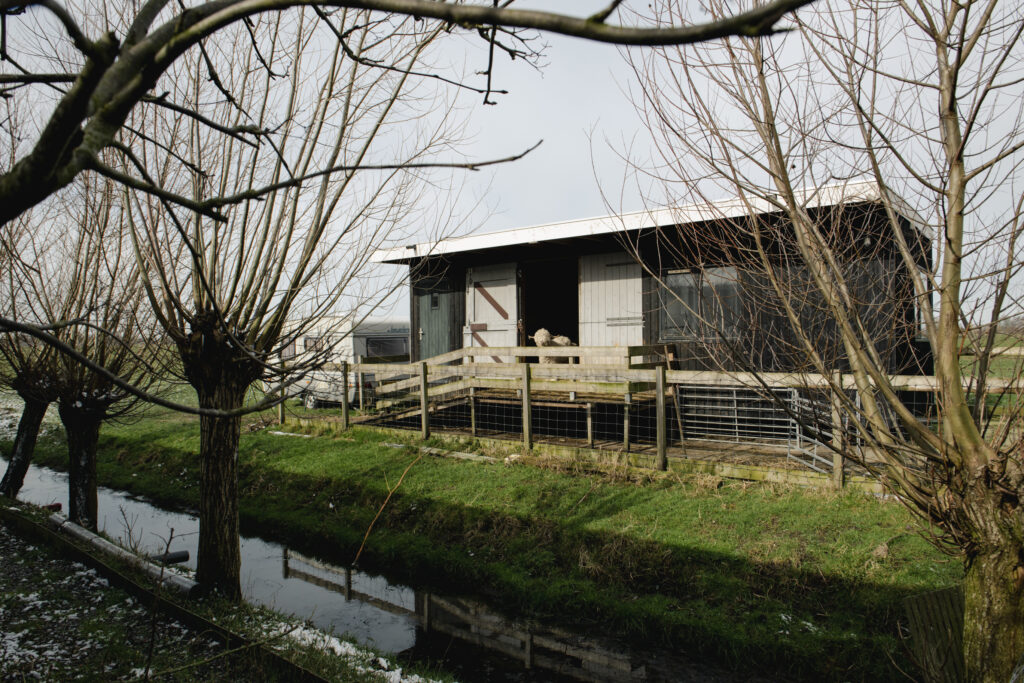
With The Knitwit Stable, Reina Ovinge wants to show that another way is possible. “We have thirty-five Merino sheep and twenty Angora goats that graze the land holistically. That means moving them regularly to new patches of pasture, so the soil isn’t depleted but actually improves – and parasite pressure decreases”, she explains. “Initially, we wanted to establish a food forest with sheep and goats. But soil research showed the land was too wet – we’re on peatland. So instead, we chose herb-rich grassland, without artificial fertilisers or pesticides.”
Uitgelichte quote
If you pay farmers fairly, there’s room to breed sheep with better fleeces
From wool to jumper
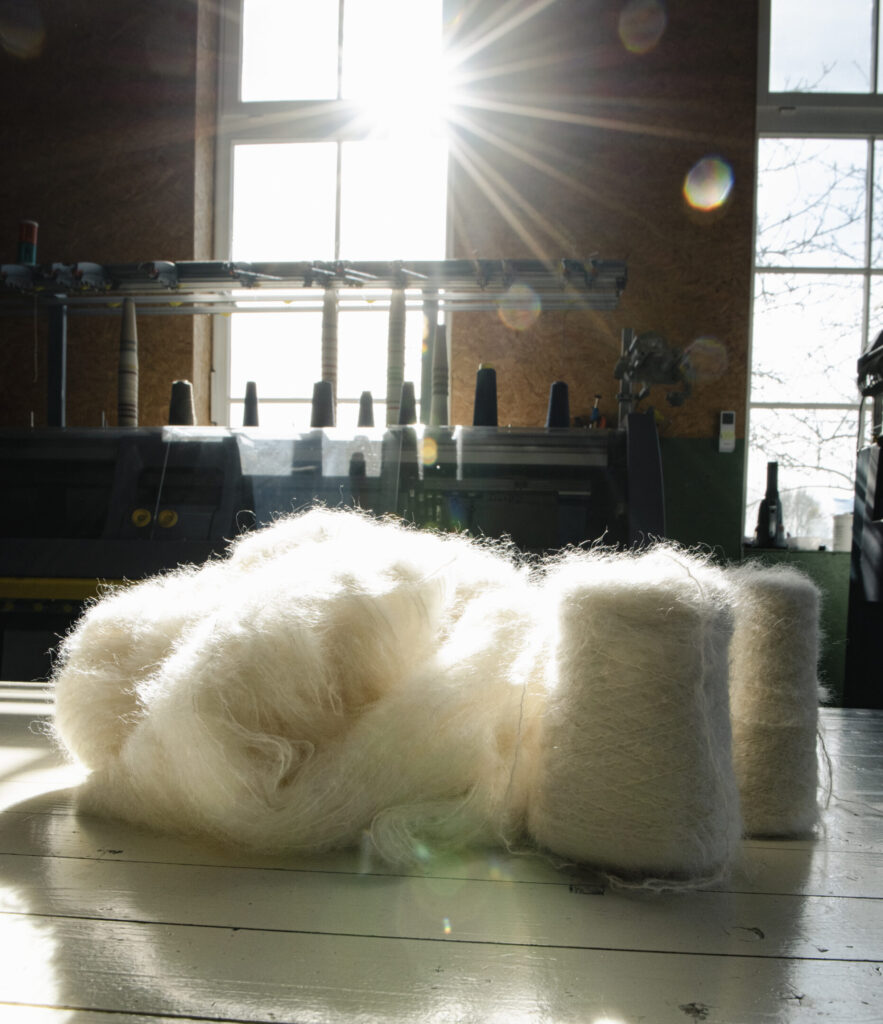
Reina and her team shear their goats and sheep with the help of a local shearer. They also work with Dutch sheep farmers, paying them a fair price for their wool. “We take the raw wool to Belgium or northern Italy, because there are no wool-washing facilities left in the Netherlands,” Reina explains. “After washing, about half of the material remains – the rest is dirt and grease. The wool is then carded and combed, leaving a beautiful sliver. From there, a spinning mill in Italy – because those no longer exist in the Netherlands either – turns it into yarn. And with that yarn, we knit jumpers and cardigans on our own knitting machines.”
“Because farmers have been paid next to nothing for their wool for such a long time, they’ve been throwing everything together for years – belly wool, leg wool, sometimes even a bit of manure, because it makes the load heavier”, Reina reflects. As a result, the quality of Dutch wool can sometimes be lacking, she admits. “But it’s a classic chicken-and-egg situation: if you pay farmers fairly, there’s room to breed sheep with better fleeces, or to clean and sort the wool by quality. That’s what we’re trying to support with the farmers we work with.”
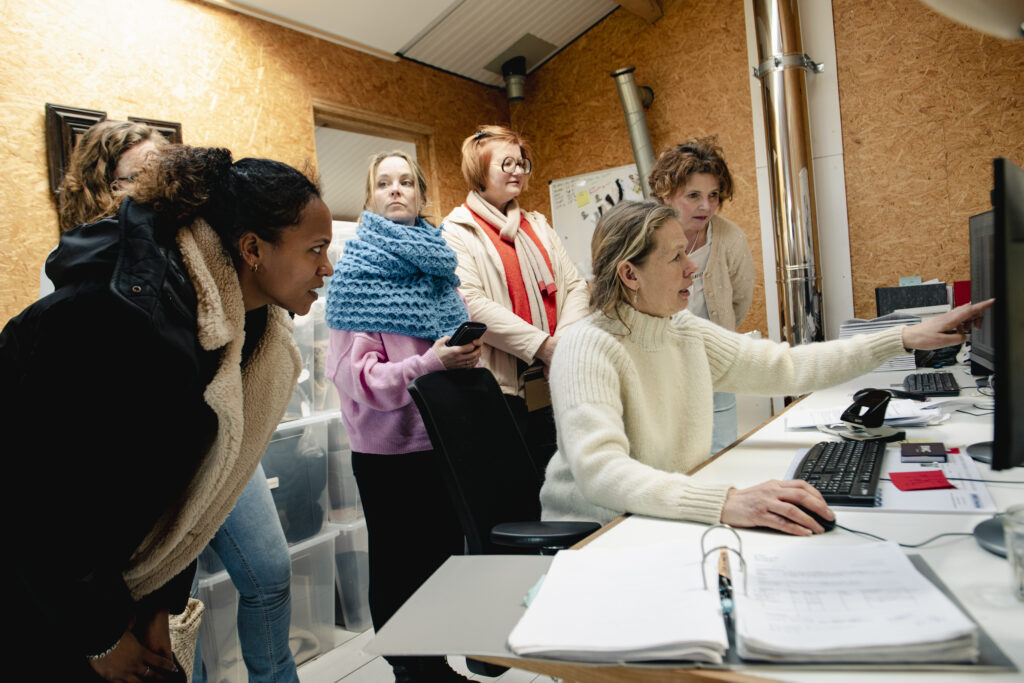
In addition, Reina advises clothing companies on how to become more sustainable and gives masterclasses to textile students. “So many young people who come here don’t want to sit behind a laptop, but want to work with their hands. That’s another reason why rebuilding a local manufacturing industry matters.”
Uitgelichte quote
Our woollen jumpers last for years, while a polyester jumper wears out much faster
 Photographer: Diane van der Marel
 Photographer: Diane van der Marel
“Exploitation and pollution are dirt cheap”
Many people are taken back by the prices at The Knitwit Stable, where jumpers and cardigans cost several hundred euros. “But we’re a foundation, so we don’t make a profit”, Reina stresses. “This is simply the true price of a woollen jumper if you pay farmers fairly, treat animals well, process the wool in Europe and don’t exploit your workers. If you want it much cheaper, you quickly end up with garment workers in Bangladesh labouring six days a week for 150 euros a month. Or with goat farmers in Mongolia keeping so many cashmere goats on tiny plots that the soil is exhausted – and the landscape slowly turns to desert.”
“Our woollen jumpers last for years, while a polyester jumper wears out far more quickly. So, you end up buying many more of them – meaning it’s nowhere near as cheap as it seems”, Reina adds. The same logic applies to a material’s footprint.
“If you compare a polyester jumper with a woollen one, polyester often performs better on paper in terms of water use and CO2 emissions. But once again, we forget that wool lasts much longer, meaning less production is needed – and that it’s biodegradable and renewable. We need a fundamental shift: from quantity to quality.”
Reina also argues for true pricing, so that local and fair production becomes the most attractive option financially. “Right now, exploitation and pollution are dirt cheap, while we struggle to make the numbers add up”, she says. “That means I – and many other local, ecological entrepreneurs – spend far too much time behind a laptop, searching Excel spreadsheets for solutions, when what we really want is to focus our energy on making the world a little more beautiful.”
Uitgelichte quote
I used to be right in the middle of the fast fashion bubble
People who care
“I love feeding the sheep and goats in the morning – being outside, among the animals,” Reina says. “But what I find most special is making something yourself: from wool to jumper. And then thinking: I made this – it’s possible.”
The Knitwit Stable has given her a more hopeful outlook on the world. “I used to be right in the middle of the fast fashion bubble. Now, every day I meet people who care – about others, about animals, about the Earth. That’s an enormous enrichment.”
 Photographer: Diane van der Marel
 Photographer: Diane van der Marel
Want to make a difference with your clothing? Here’s where to start:
– Ask yourself with every purchase: do I really need this? The most sustainable option is often the one you already own.
– If you do need something, consider borrowing, swapping or renting clothes – from friends or a clothing library. Better still: organise a clothes swap.
– When buying second-hand, prioritise good quality and natural, biodegradable materials such as cotton, hemp, linen and wool.
– Buying new? Choose items designed to last at least ten years and opt for natural and organic materials, free from agricultural chemicals, preferably with GOTS certification. Where possible, support companies such as Joline Jolink and The Knitwit Stable, which produce their clothing ecologically in Europe, avoiding exploitation and long transport chains.
Looking for more regenerative initiatives? Explore our map.
Originally published on the 5th April 2023. Latest update: 20th of January 2026.

READ MORE:

Claudy Jongstra: “Natural dyes are the gold of the future”
12 February 2025