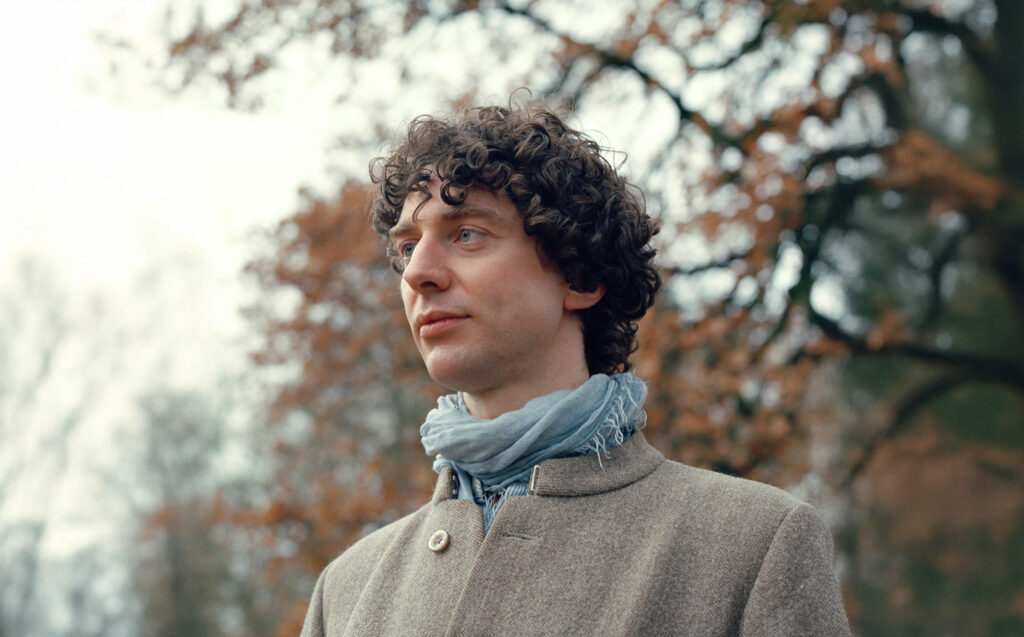
Louise Vet: “Nature has been working for 3.8 billion years to come up with the best solutions”

The road to restoring biodiversity in the Netherlands runs through agriculture. In this interview, ecologist Louise Vet shines her light on systems thinking and tipping points, the importance of variation, and how nature turns out to be far more ingenious than we thought. “We need to move from ‘I’ to ‘we’ – and that ‘we’ should be so broad it includes plants and animals, too.”
How would you describe the state of biodiversity in the Netherlands right now?
“Very bad. In a European context, we are the worst pupil in the class, at every level of biodiversity: species richness, genetic variation within species, interactions in ecosystems, and landscape diversity. But I always add this: nature is incredibly resilient, and if we give her the chance, recovery is always possible. You can already see populations of wolves, otters and beavers cautiously increasing again. I’m not only about doom and misery; I also want to show that there is always hope.”
What are the causes of that loss of biodiversity in the Netherlands?
“In general, when people talk about biodiversity loss, they mention urbanisation, the disappearance of habitat, pollution, drying out, overhunting, the introduction of invasive non-native species. But in the Netherlands – however you look at it – we have to look at intensive agriculture and the way we have organised it.”
Uitgelichte quote
In the Netherlands we have to look at intensive agriculture – and the way we have organised it
Why does agriculture play such an important role in biodiversity loss?
“Primarily because of the loss of landscape variation and the monocultures – the sheer uniformity, which is by definition the opposite of biodiversity. A ryegrass pasture is basically green asphalt: almost nothing can live there except the grass itself. Then there are the problems of agricultural chemicals, artificial fertiliser ending up in the water, and the loss of functional life in the soil.
Two factors make the impact of intensive agriculture on nature even greater. First, the enormous amount of land in the Netherlands used for agriculture – about fifty-five per cent of our country. Second, the downsides of intensive farming hit the very base of the food chain: soil life and insects. If the foundation of the system is damaged, everything is at risk. That also helps explain the dramatic decline of farmland birds in the Netherlands, for example.”
Uitgelichte quote
Biodiversity is the foundation of well-functioning ecosystems
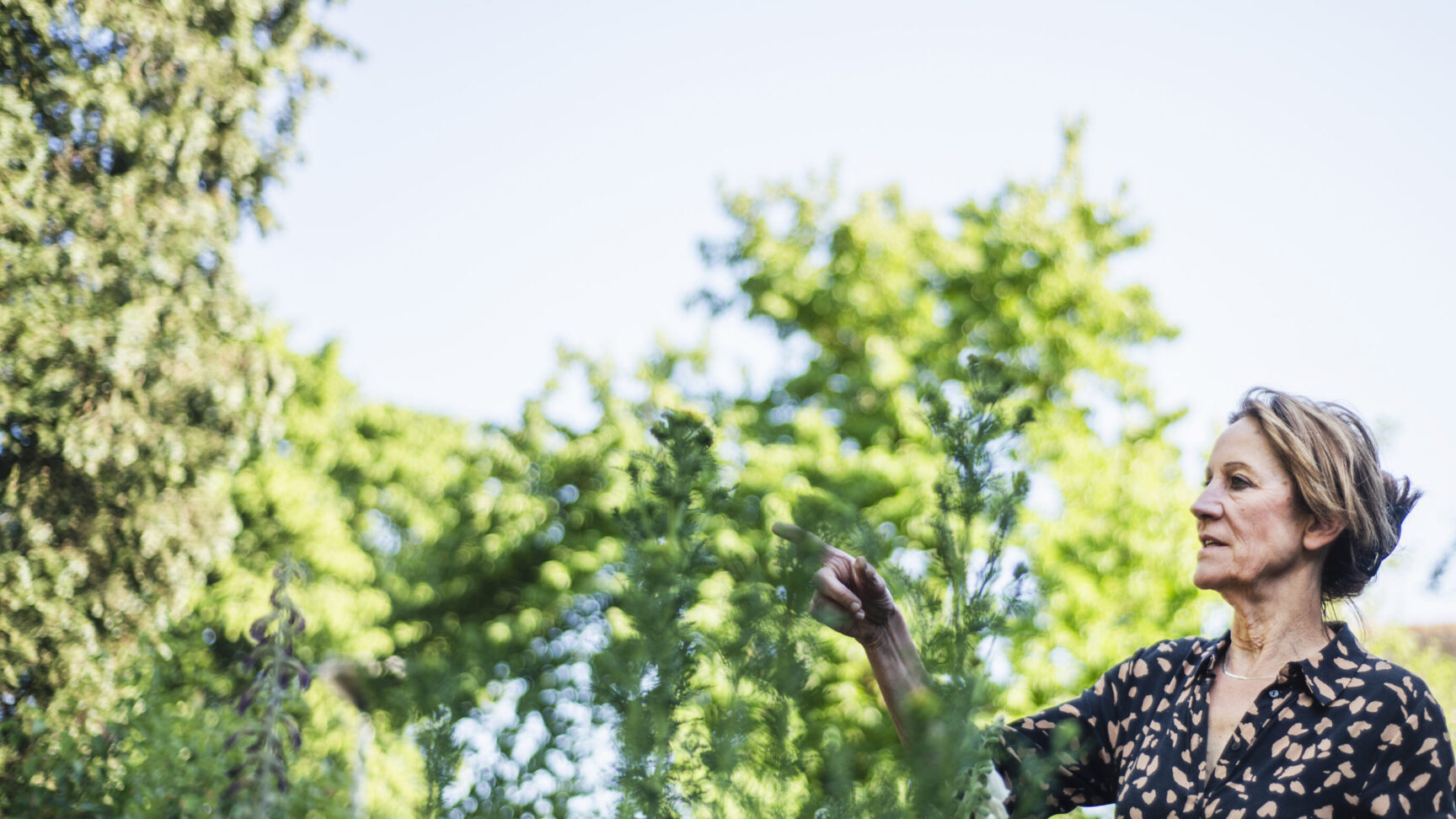
 Louise Vet: “If the foundation of the system is damaged, everything is at risk.” Photographer: Gabriela Hengeveld
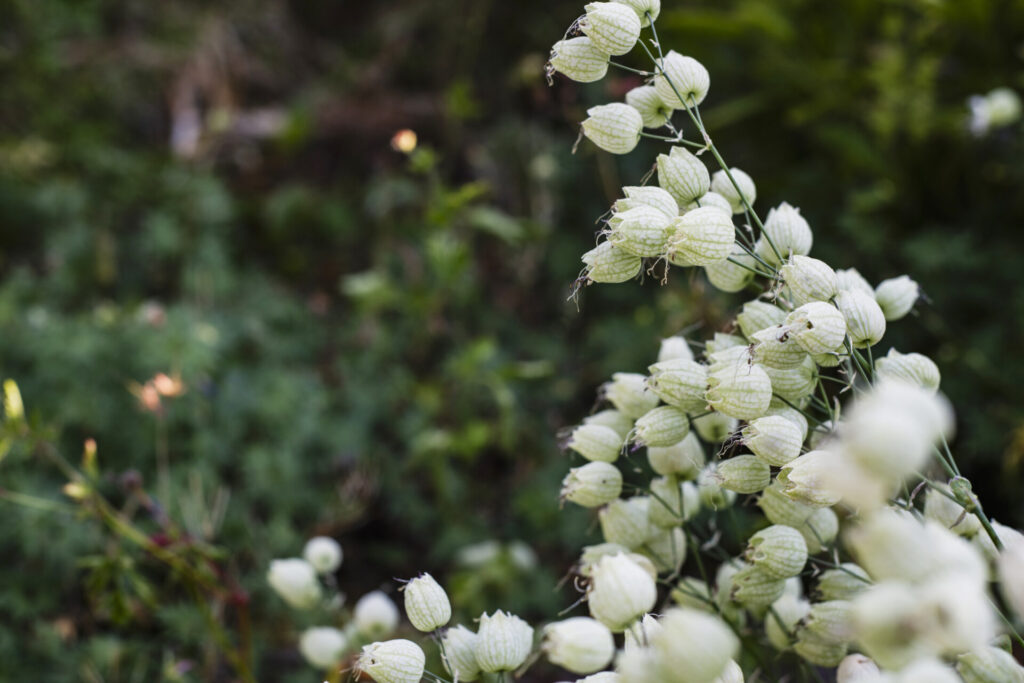 “The whole idea behind sexual reproduction is genetic variation.” Photographer: Gabriela Hengeveld
Why are we so devoted to monocultures?
“We go for the cattle breed that produces the most milk, the grass that grows fastest, there is little variation in crops and landscapes, and there are hardly any mixed farms left at all. Everything has been maximised; all the frills have been stripped away. It is the agronomic, old Wageningen way of thinking: we have to feed the world, and only maximising yield at the lowest possible cost – ‘efficiency’ – counts.”
Uitgelichte quote
Damage to biodiversity is not included in our economic system. Private profits, public costs
In that mindset, biodiversity really is ‘frill’ – nice to look at, but not valuable?
“That is precisely the greatest misconception of our time. Biodiversity is the foundation of well-functioning ecosystems, and ecosystems provide ecosystem services: fertile soils, drinkable water, clean air, crop pollination and more. Ecosystems do this for us free of charge, and so they do not appear in the accounts. We like to say the polluter pays, but the polluter does not pay at all: damage to biodiversity is not included in our economic system. Private profits, public costs.”
Uitgelichte quote
We keep pulling blocks out, and at some point the whole system comes crashing down
 Photographer: Gabriela Hengeveld
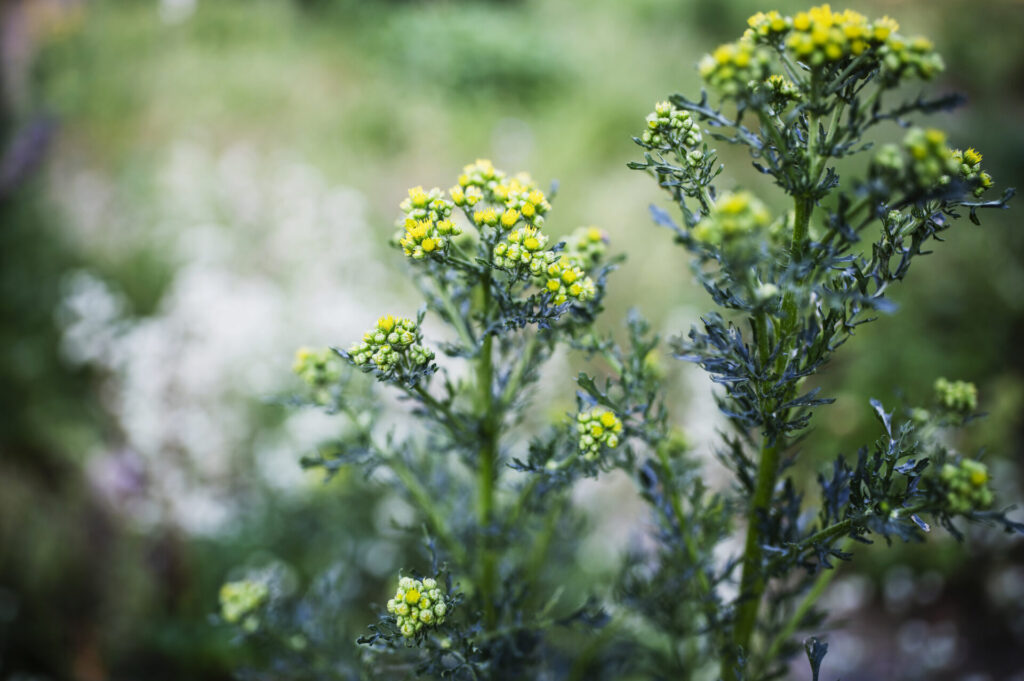
 Louise Vet: "Variation makes the system more robust, more resilient, and gives it more options." Photographer: Gabriela Hengeveld
Why do ecosystems need biodiversity?
“Biodiversity creates variation, and that is essential for ecosystems. It is about spreading risk and gaining adaptive advantage. At the genetic level: the whole idea behind sexual reproduction is genetic variation, from which beneficial traits can emerge, such as resistance to disease or other useful adaptations. If a population is genetically impoverished, it becomes more vulnerable.
The same applies at the level of species, ecological interactions and landscapes. Variation makes the system more robust, more resilient, and gives it more options. In agriculture, for instance, diverse arable land is far less vulnerable to pests.”
Uitgelichte quote
For a long time we acted as if soil was a dead thing, and we poured artificial fertiliser onto it like fast food
When will people start noticing ecosystems that no longer function?
“In many places around the world, we have been noticing for a long time: exhausted agricultural soils, fishing grounds that no longer yield anything, and of course climate change. The question is how far we are from the major tipping point. It is like Jenga, that tower of wooden blocks. We keep pulling blocks out, and at some point the whole system comes crashing down.
A good example in the Netherlands is freshwater ecosystems. Nitrate and phosphate run into them from agricultural land, causing eutrophication: too many nutrients. That boosts algal growth, which allows less light to penetrate the water, killing aquatic plants. Then pike lose the cover they need to hunt from, allowing a species such as bream to increase – a fish that churns up the bottom, clouding the water with mud. This can happen quickly; it can flip suddenly, and then you have murky water everywhere.
There are theories suggesting that the speed at which such an ecosystem recovers says something about how close you are to the catastrophic tipping point. Many ecosystems now have increasingly long recovery times.”
Uitgelichte quote
If our current way of farming is the main cause of biodiversity loss, then it is clear that the path to recovery also runs through agriculture
 Louise Vet: “Diverse arable land is far less vulnerable to pests.” Photographer: Gabriela Hengeveld
 “Nature, with all its diversity and variation, is not so crazy after all.” Photographer: Gabriela Hengeveld
Should we be looking to regenerative agriculture for the solution?
“If our current way of farming is the main cause of biodiversity loss in the Netherlands, then it is clear that the path to recovery also runs through agriculture. The essence of regenerative agriculture is that it does not work against nature, but with it. Nature-based solutions, we call that. With all the ecological knowledge we have built up by now, I am optimistic that we can turn the tide through regenerative agriculture.”
Uitgelichte quote
We know more about craters on the moon than about the soil life beneath our feet
What ecological knowledge are you thinking of?
“We already knew that plants produce substances to defend themselves when insects feed on them. But later we discovered they also release scents into the air to attract precisely the predator that eats those insects, or exactly the parasitic wasp that lays its eggs inside them. They are calling in the enemies of their enemies.
We now also know that growing plants influence the soil microbiome in ways that benefit them. After harvest, the next plant makes use of that altered microbiome. I often call it a ‘voicemail message left behind’, or a microbial memory. Or take insects, which can sometimes learn better than dogs, or soil bacteria that produce antibiotics. The whole system is so much richer in interactions than we thought.”
Uitgelichte quote
The planet has no lobbyists, no lawyers, and it does not strike, until it does. And then it's too late
It can feel as if we humans are charging through that ingenious system like a blind horse…
“That is exactly what we are doing. We know more about craters on the moon than about the soil life beneath our feet. For a long time we acted as if soil was a dead thing, and we poured artificial fertiliser onto it like fast food. Only now are we discovering how fascinating and important soil life is, with microorganisms, fungi and plant roots. That soils under regenerative agriculture retain water far better during drought than soils under intensive agriculture. How useful that whole library of helpful insect species is.
And this applies in many areas: a dike with herbs growing on it is stronger than one with only grass, because the roots hold the soil more securely. Nature, with all its diversity and variation, is not so crazy after all.”
Uitgelichte quote
If we give her the chance, recovery is always possible
Is that, for you, the most important insight?
“Nature does everything for us. Think of it as a research and development department that has been working for 3.8 billion years to come up with the best solutions. I like to name three lessons I have drawn from nature as an ecologist – lessons that should shape our worldview.
First: all energy comes from the sun. The closer you stay to that – through solar power and plant-based food – the more efficiently you use energy. Second: everything is a cycle. Waste does not exist; everything is food for something else. Third: all life thrives on diversity and variation.”
 Louise Vet: “Nature loves mess.” Photographer: Gabriela Hengeveld
 Photographer: Gabriela Hengeveld
Is our worldview moving in that direction already?
“Gradually. Many farmers and citizens still talk about weeds, lawns must be kept short, the garden should be ‘clean’. But nature loves mess. What we call mess is variation. If you dig a small hollow in your garden, you create a microclimate that can support biodiversity. Our thinking still needs to take a few steps forward. We must relearn how to think in systems. To realise how everything is connected to everything else – the core idea of ecology. From ‘I’ to ‘we’ – and that ‘we’ should be very broad. So broad that under ‘we’ we also include plants and animals.”
Uitgelichte quote
The task is to figure out what we should do – and what we should stop doing – to give natural systems space again
If nature is such a sophisticated system, isn’t it presumptuous to think we can ‘fix it’ with regenerative agriculture?
“That belief in ‘manufacturability’ is indeed an important part of what we might call the ‘old view’ of nature: the idea that we can see everything and bend everything to our will. Taking a step back and looking at the rest of life on Earth with some humility – and wonder – would do us good. But humans are also highly intelligent. It depends on which lesson we want to learn.
The task is to figure out what we should do – and above all what we should stop doing – in order to give natural systems space again. And that is also the essence of regenerative agriculture.”
Uitgelichte quote
Banks could offer lower interest rates to farmers practising regenerative agriculture
 Louise Vet: “Don’t blame farmers – they, too, are caught in the trap we have all set.” Photographer: Gabriela Hengeveld
 “We should start seeing farmers as landscape managers.” Photographer: Gabriela Hengeveld
What role do you see for farmers in this transition?
“Right now they are seen only as entrepreneurs who are financially dependent on their yields, but we should also start seeing farmers as landscape managers. People who receive public money for, for example, creating and maintaining landscape features. We do the same with other public utilities, such as infrastructure. And they should be paid on a long-term basis – say, thirty years – so farmers have perspective.
That financing could also come from multiple sources; we sometimes call that ‘stacking’. Banks could offer lower interest rates to farmers practising regenerative agriculture. Water boards could reward farmers who help improve water quality. Companies could pay for carbon storage, and so on. It works best when bottom-up initiatives match top-down regulation.
We can develop these kinds of initiatives with a positive attitude, without wagging a finger. Not blaming farmers – they, too, are caught in the trap we have all set. We are not going to bash farmers; I see farmers as part of the solution. But we do have to acknowledge that there is no more room for intensive agriculture.”
Uitgelichte quote
It’s an embarrassing spectacle that’s driven by the agricultural lobby
How do you view, in this context, the resistance of Dutch MEPs to natural restoration laws?
“It’s an embarrassing spectacle that’s driven by the agricultural lobby, which basically wants to get rid of the Natura 2000 areas. It frustrates me at times, too. In the Netherlands we always deny for a long time that there is a problem. You see it with climate change, and with the nitrogen crisis. We let that simmer for years and now twenty-five billion euros are needed to solve it.
When we can no longer deny there is a problem, a committee is formed. It delivers advice that then enters the political arena. And in every round it gets watered down until very little remains, and the economy wins again – but it is the economy of private profits and public costs. And now we are running into the consequences. The planet has no lobbyists, no lawyers, and it does not strike … well, not until it really does, and then it is too late.”
Uitgelichte quote
I like to stress the importance of nature for our health, both mental and physical
Biodiversity is still often sold as something we ‘should’ do, but isn’t it also about regaining a beautiful, varied countryside?
“Yes, regenerative agriculture can certainly give you a more beautiful countryside. But ‘beauty’ is subjective, and it seems especially hard to reconcile with an entrepreneurial mindset. I like to stress the importance of nature for our health, both mental and physical. Study after study shows how beneficial a green environment is. That is true in cities as well, where greenery helps against heat stress, flooding and fine particulate pollution. Access to nature, and experiencing something in nature – in fact it should be a human right.”
Also dive into our interview with ecologist and ecosystem restoration expert John D. Liu.
Originally published on the 19th of December 2023. Latest update: 5th of May 2026.
Who is Louise Vet?
Louise Vet is an emeritus professor of evolutionary ecology at Wageningen University and Research and was director of the Netherlands Institute of Ecology (NIOO-KNAW). She researches agro-ecosystems and serves on a large number of advisory councils and committees, such as the Remkes Committee (Advisory Council on the Nitrogen Crisis). She is, among other roles, chair of Deltaplan Biodiversity Recovery, chair of the board of Urgenda, and a member of the supervisory board of WWF Netherlands. In 2018 she was number one in Trouw’s Sustainable 100, and in 2019, on her departure from NIOO-KNAW, she was appointed Knight in the Order of the Dutch Lion.
READ MORE:

Vandana Shiva: “In a living economy, we participate in the natural world as equals”
26 February 2026