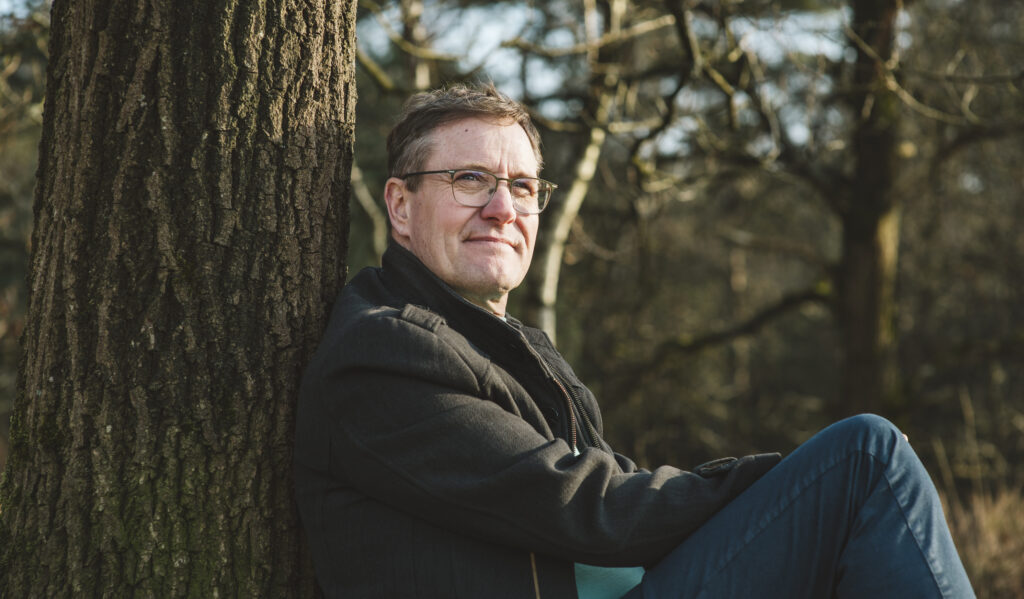
Rob Hopkins: “Climate change is a failure of the imagination”
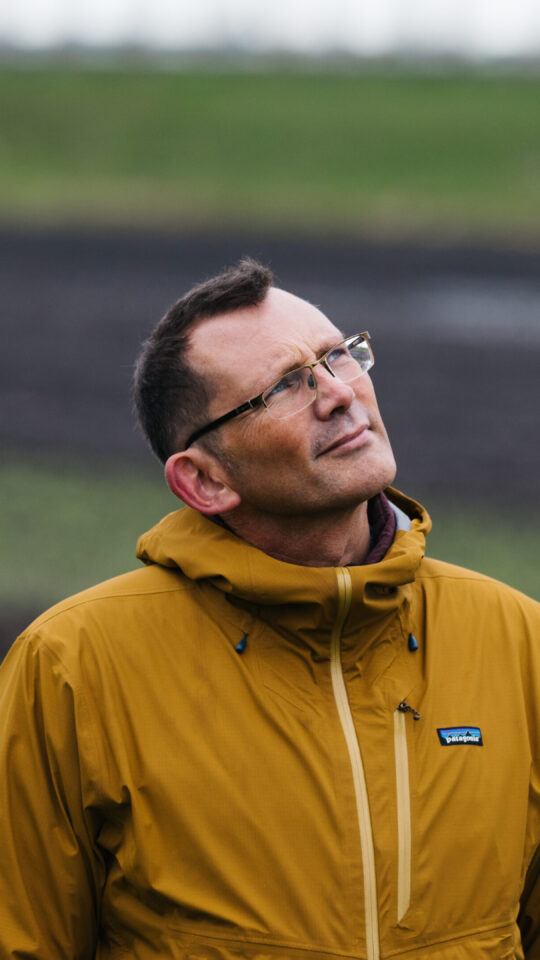
Rob Hopkins has spent the past decades exploring one question: what if we could fall in love with the future? As co-founder of Transition Network and Transition Town Totnes, and author of four books, he travels the world helping communities cultivate imagination, longing and possibility. He believes that the transition we so urgently need depends on one thing above all: imagination.
Your dream is living in balance with our planet. What has inspired you to dedicate your life to this topic?
“When I was younger I didn’t go to university, I travelled. I spent time in a monastery in Tuscany that practiced Tibetan Buddhism, which really shaped the way I see the world. And then I travelled through South Asia, and in Pakistan I went to the Hunza Valley. It was the first time I saw what a society living in balance with its environment actually looked like: terraced fields, communities growing their own food, houses built from local materials. It planted the idea that humans can live in a way that works.
Later I discovered permaculture. An old friend of mine gave me a copy of Bill Mollison’s book, Permaculture Designers’s Manual. One of the first chapters is called ‘Earth Repair’. It blew my mind. For years I’ve been surrounded by ‘anti-stuff’, and this book was all about how to put things back together again. So ever since I opened that book, doing that has been the mission.”
Uitgelichte quote
Talking about collapse and extinction just shuts people down
What is holding back the transition we need?
“Before answering that question, I would like to give some context. From the biggest global survey of attitudes around climate change, we know that 89 percent of people are really concerned about climate change and want rapid action. But when we ask them how many people they think share that belief, the answer is 40 percent. So, while we are a majority, we think we’re a minority. That’s profoundly disempowering.
We tend to believe that we didn’t achieve much in the past years. Oil and gas, plastic, meat and chemical companies spent an enormous amount of money on incredibly skilled disinformation campaigns to make us believe that. Since Paris 2015, there has been a huge concerted pushback. You see it in things like Project 2025 in the US, the Atlas Network, the work of the Koch brothers.
We have to realize the level of influence that oil and gas companies have, and their ability to manipulate. Nothing in human history has ever made so much money as the oil and gas industry. They won’t go out without a fight. Imagine the transition movement had the resources that the oil and gas companies are pouring into disinformation, political lobbying, bribery and corruption right now. We’d solve all the problems right away. It would be just phenomenal. So, it’s about power – and the power sits in the wrong places.
To answer your question: what’s holding back the transition? It comes down to two things. The first thing is that even though it’s not really attractive for a lot of people, we’re creating propaganda for gloom and doom instead of offering an attractive alternative. The other one is that there are so many brilliant initiatives, but they are all living on their own island instead of collaborating with each other. The left and more progressive movements are very good at just finding all the reasons not to agree with each other. The right movements are better in pursuing their goal together. At this point, it’s like a football match and we’re 3-0 down at halftime. We’d have to work hard to come back from that, but it’s definitely possible.”
Uitgelichte quote
I turn the whole room into a time portal and take them to 2030


Your latest book How to Fall in Love with the Future is about imagination, longing and possibility. What triggered you to write it?
“Since 2006, I have essentially worked for Transition Town Totnes, the transition movement I co-founded. For 13 years my role was mostly about scanning this network for stories. One day I sat down with people from a foundation in Belgium. They told me they loved what I do and asked how they could help me make myself and my work more visible. No one had ever asked me that question before, so I started to investigate how I wanted to use this opportunity.
It was around that time that within the space of two or three months, I read a few articles where the authors stated that climate change is a failure of the imagination. At the same time I saw a photograph of a woman on a Black Lives Matter-protest. She had this t-shirt that said: ‘I’ve been to the future. We won.’ It gave me goosebumps. Back then, the biggest narrative in terms of climate activism came from Extinction Rebellion. It was very much about how doomed we were.
That woman’s t-shirt was something that changed me. Weeks later I went to London for a talk for Extinction Rebellion. Instead of talking about extinction, collapse and how fucked we are, I went there wearing a hazmat suit and a pretend space helmet and I told the audience that I just came back from 2030 and that it was amazing. There were rooftop farms, regenerative agriculture and bicycle rush hours. Shell and BP collapsed and the king gave all of his land to rewilding. I saw how it moved people and realized this is what we need: we need desire, hope and imagination. It made me wonder: what happens when we help people create memories of the future? How do we cultivate that longing? That question led to How to Fall in Love with the Future and became the heart of the book.
The key questions are ‘What would our activism look like if the cultivation of longing was its primary objective?’ And: ‘What if we would shape our activism as if time travel was possible?’”
Uitgelichte quote
One person said it felt like a fist unclenching
Is ‘time travel’ how you help people cultivate longing for the future?
“What I’ve discovered is that longing appears when you take people to the future in a way that feels real. After this moment at Extinction Rebellion I did a lot of ‘time-travel work’: I bring my time machine – this very powerful quantum technology – and I ask people to close their eyes. I turn the whole room into a time portal and take them to 2030, usually the 2030 that results from us doing everything we should have done. I ask them to walk around using all their senses: what does it smell like, feel like, taste like? Then, with their eyes still closed, they turn to the person next to them – ideally someone they didn’t know before – and describe what they saw. If you keep your eyes closed, you’re still there, you can still see it, so the descriptions come from a very embodied place.
After that we hear from the whole room, and what people describe is astonishingly similar: cleaner air, louder birdsong, cities that feel softer, people who look less stressed. One person said it felt like a fist unclenching. We then make collages or images of what they saw, creating a kind of gallery of their futures. When people have really ‘been’ there, it creates this longing, this nostalgia for the future. It opens things up. It creates possibility. And it’s so different from talking about collapse and extinction, which just shuts people down. Longing comes from helping people experience a future they would actually like to live in.”
Uitgelichte quote
Hope isn’t something passive, it comes from doing the work
 "If you spend time around the movements trying to do something and you don't feel optimistic, then you don't have a heart.” Photographer: On a hazy morning
 Rob Hopkins: “It opens things up. It creates possibility.” Photographer: On a hazy morning
Do you ever feel despair?
“Of course. If you don’t feel despair, you’re not paying attention. Like Paul Hawken said: ‘If you read the climate science and you don’t feel pessimistic, then you haven’t read it properly. But if you spend any time around the movements trying to do something about it and you don’t feel optimistic, then you don’t have a heart.’ I kind of feel like that. So for me, despair is part of the landscape. But so is hope.”
And hope is your antidote to despair.
“In a way, yes. Rebecca Solnit says hope is not a lottery ticket you clutch sitting on the sofa, it’s an axe you use to break doors down. And Yvon Chouinard always said that action is the best remedy for depression. Hope isn’t something passive, it comes from doing the work, from being around people who are actually trying to change things, from feeling the momentum that’s already there. Despair is real, but hope is what keeps me moving.”
Uitgelichte quote
I always say we should stop using the word ‘impossible’ and replace it with ‘not yet’
 Rob Hopkins: “We had a great story and people wanted to make it happen.” Photographer: On a hazy morning
 “What if, in one generation’s time, the majority of food in Liège came from the land closest to Liège?” Photographer: On a hazy morning
What gives you hope?
“My hope comes from the things I’ve actually seen. The places I’ve been, the people I’ve met, the projects I’ve been involved with and helped to kickstart. I know what’s possible because I’ve seen it with my own eyes. And I genuinely love human beings: we’re capable of the most exquisitely beautiful, compassionate, loving things. I always say we should stop using the word ‘impossible’ and replace it with ‘not yet’, because any useful statement about the future should at first seem ridiculous. And there are real signs of hope: in the UK, Zack Polanski’s election as leader of the Green Party has tripled membership and put them ahead of Labour in some polls; and in the US, despite all the Trump climate stuff, cities are just getting on with it. The momentum isn’t slowing. People are ready for a shift. That gives me hope.”
Uitgelichte quote
We need to fill the future with delicious stories, narratives and dreams
What do you believe we need most right now?
“I’d say: we need a positive futurism activism movement and politics that helps people fall in love with the future. Because at the moment the right is filling the future with these terrifying visions – all based on fear – and then saying: “We are the strong men and we will protect you from that.” At the same time, many climate movements are painting terrifying visions too. So where are people supposed to go? They’re like a rabbit trapped between two sets of headlights, and none of it is very attractive.
We need to fill the future with delicious stories, narratives and dreams. We have to give people something to run towards, rather than just things to run screaming in the opposite direction from. What gives me confidence is that I feel people are truly ready now for a kind of activism and politics rooted in reimagination and possibility.”
Uitgelichte quote
When I went back to Liège in 2018, they had started 30 new cooperatives and raised €5 million
 Rob Hopkins: “Action is the best remedy for depression.” Photographer: On a hazy morning
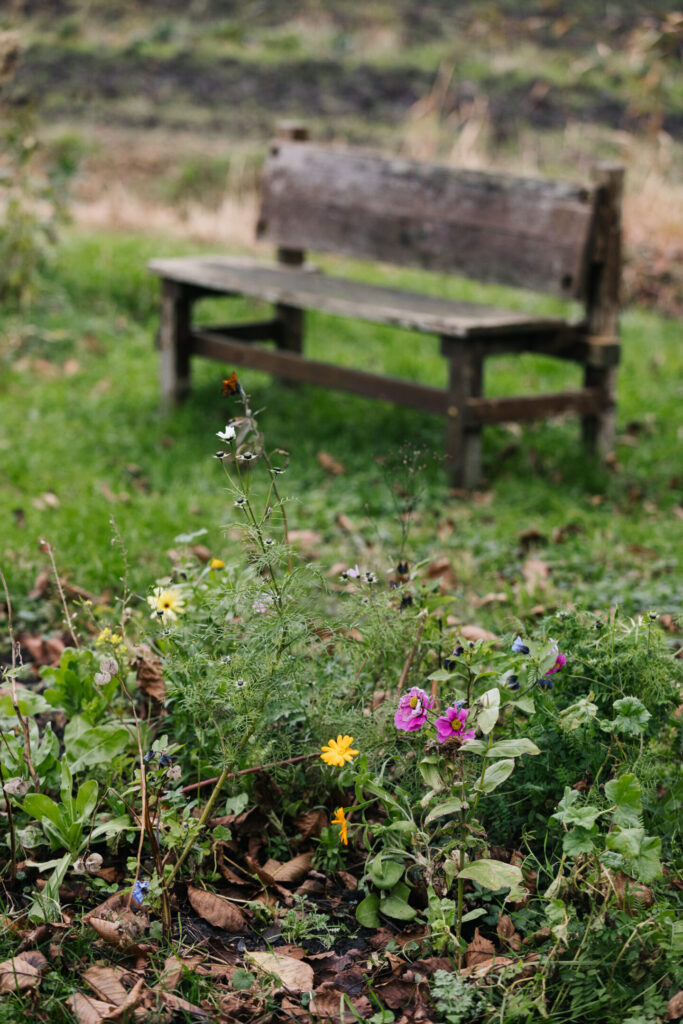 “I know what’s possible because I’ve seen it with my own eyes.” Photographer: On a hazy morning
Are there places where we can already experience the future we want to live in?
“Yes, I’ve seen fragments of that future in many places. The solar-powered restaurant project in Marseille, the bicycle rush hour in Utrecht, Vauban in Freiburg – which is the biggest car-free neighbourhood in Europe – regenerative farms, landscapes rewilded by beavers, even an underground mushroom farm in Brussels. These places give a glimpse of what’s possible.
But for me, Liège (Belgium) is the closest thing to that future. Liège was one of the first Transition groups in Belgium. It was a postindustrial city that no one was very excited about. Around 2011 they asked a What If-question: what if, in one generation’s time, the majority of food in Liège came from the land closest to Liège?
They created the Ceinture Aliment-Terre Liégeoise, the Liège Food Belt. In 2014 I went to their first big event and they thought maybe 200 people would show up. 600 people came. When I went back in 2018, they had started 30 new cooperatives and raised €5 million – not from the bank or municipality, but from the people of Liège themselves. One guy started a cooperative vineyard and raised €2.5 million. When I asked how he did it, he said: “It’s Belgian. People like wine. People have some money. We had a great story and people wanted to make it happen.”
The municipality first thought this transition group was insane and things would never work, but over time they completely changed course and asked: ‘How can we help?’ They created CREaFARM, mapping all the public land around Liège and leasing it at very low cost to growers. They now have a food logistics hub, produce thousands of school meals every day using local ingredients, and have multiple shops in the city. The model has spread to six other cities in Belgium. Every time I go back, they are doing something new that I would never have thought of. They have no sense of limitation – everything is possible. It feels like freedom.
The model of Liège is a model whose time has come. If you’re a responsible city planner looking at the uncertainties in the world right now, you build up a food belt like Liège. In 2030, that’s the new normal. Everywhere is a food belt.”
Uitgelichte quote
Sometimes it even feels like we’re hearing the last noises of an old worldview dying
 Rob Hopkins: “I sense a growing hunger for different stories about the future.” Photographer: On a hazy morning
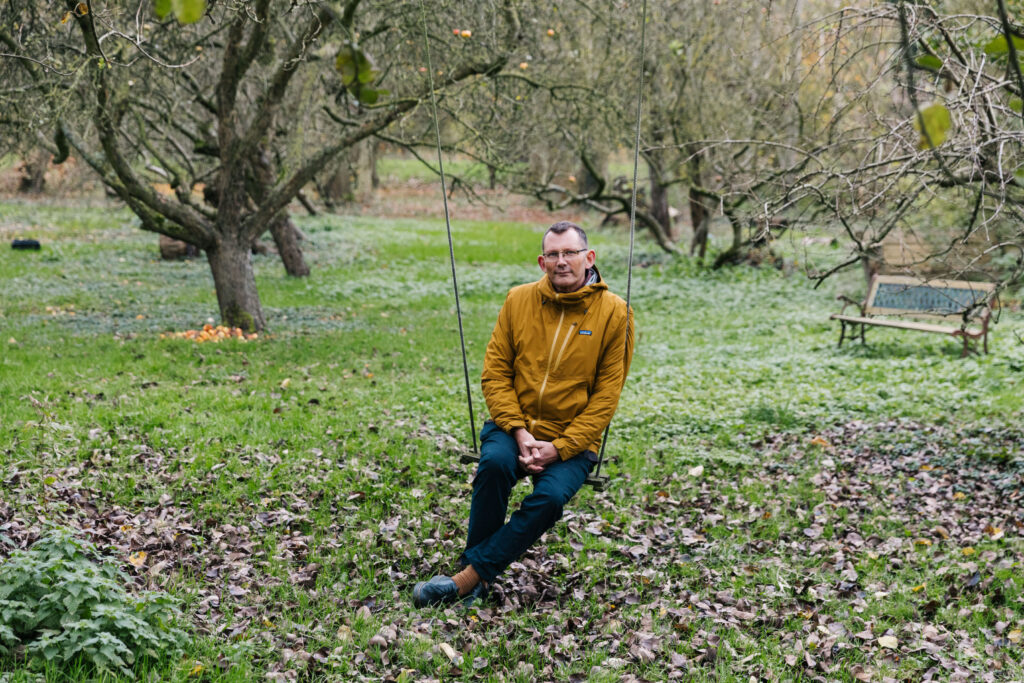 “People are reclaiming the future as something we create rather than endure.” Photographer: On a hazy morning
Are we witnessing the end of one story and the beginning of another?
“I think we are. And sometimes it even feels like we’re hearing the last noises of an old worldview dying. A friend of mine once said that when you’re using a chainsaw, just before it runs out of petrol it suddenly accelerates – that strange final surge. I often think about that when I look at what’s happening right now. It can feel like the noise the dinosaurs must have made when they saw the meteor coming: loud, desperate, a final roar of something whose time has come.
At the same time, everywhere I go, I sense a growing hunger for different stories about the future. People are tired of being told that the only future available is collapse or chaos. There’s an opening now – especially among younger people – for imagination, for possibility, for futures that feel beautiful and lived-in. You see it in culture, in Afrofuturism, in new forms of storytelling, in people reclaiming the future as something we create rather than endure. It feels like the ground is softening. It’s ready. We’re ready.”
Original publication date: 17th of December 2025. Latest update: 3rd of February 2026.
Who is Rob Hopkins?
Rob Hopkins is a British environmental activist, writer, and community builder. As co-founder of the Transition Network and Transition Town Totnes, he develops ideas and encourages communities to build resilience and reduce fossil fuel dependence through local action, permaculture, and imagination to create sustainable futures. Through his books and talks, Hopkins inspires people to imagine and actively create a more sustainable, community-led future.
READ MORE:

Nora Bateson: “How our ways of knowing shape our collective future”
27 October 2025